
Termites are part of the living soil in many dryland landscapes. Some process dead plant material; some can damage crops or timber. Finding termites under mulch does not, by itself, explain why a plant is failing. Start by examining both the insects and the damage.
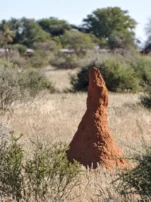
Photo: Alexander Klink · Original photograph · CC BY 4.0. Unchanged; displayed at reduced size.

Local experience — Namibia
What growers in Namibia have observed
The local discussions contain different experiences. One grower described injury to olive stems and reported that diluted dishwashing liquid usually helped. Another observed that organic material in a regularly moistened pit was left alone, while dry years brought damage to maize and other crops. A contributor encouraged starting in a small promising area, growing more supporting vegetation and treating termites as part of the dryland ecosystem. Others reported vinegar use or suggested wood ash, charcoal, biochar and wood vinegar. These accounts are retained as experience and ideas shared in Namibia; they do not establish a single cause or a treatment that works everywhere. The records do not give consistent species identification, controls or follow-up periods. Household mixtures can also injure plants or affect soil: the reported results are not a recommended spray or drench recipe. Begin with observation and a small comparison of moisture and habitat management; seek crop-specific advice before applying a treatment.
Where it fits
This guide is for gardens, young trees and crop plots. Building timber needs a separate structural assessment. In a garden, the aim is to protect plants while understanding what is happening, rather than treating every mound as a problem.
Observe before choosing a response
- Photograph the whole plant, the affected part and any termite galleries. Note the date and recent watering or rain.
- Look for fresh feeding on living roots or stems, compared with activity confined to dead mulch or old wood.
- Compare affected plants with nearby healthy plants of the same kind. Note differences in soil moisture, drainage and exposure.
- Mark a few plants and check them regularly. Record whether injury spreads, stays unchanged or stops.
- Seek identification and a diagnosis when living plants are being lost. Share the photographs and observations with an agricultural adviser.
What research suggests
Field research in western Ethiopia tested maize with crop diversification and organic amendments. Some combinations reduced termite injury and improved results. These were site-specific trials, not evidence that one mulch recipe controls every termite species. Read the study summary.
Research in Namibia also found a beneficial association between trees and colonies of Macrotermes michaelseni. Shade and vegetation can form part of termite habitat; “plant more shade and termites disappear” is too simple a claim. Namibian tree–termite study.
Water, mulch and microclimate
Keep moisture observations alongside the damage record. Check whether water actually reaches the root zone and whether one spot stays dry or waterlogged. If you test a different mulch arrangement, keep a comparable area unchanged where practical and alter only one factor. Count damaged plants as well as visible insects. This is a learning method, not a proven treatment.
Common mistakes and limits
A mound near a declining tree does not establish causation. Nor does termite activity prove that the soil lacks organic matter. Record any treatment experience with the plant, mixture, conditions and outcome, including damage or failure. A damaged plant needs a diagnosis before another substance is added.
Do not break open a mound merely to investigate garden damage. If the concern involves a house, stored timber or a structure, ask a qualified pest-management professional to inspect it.
Try this today
Choose one affected plant and one healthy comparison. Take photographs, check their watering patterns and write down exactly which tissues are damaged. Repeat the observations before deciding whether the problem is changing.
Watch, understand, adapt
How termites use microbes to eat wood
Source and location: Linked by Princeton University’s Zhang Research Laboratory, United States. The filming location is not confirmed.
A science explanation with Xinning Zhang and Ed Yong about the microbes that help particular termites digest wood. It provides biological background, not a crop-control demonstration.
 Watch video▶ Watch at the original source
Adapt for Namibia: Termite species have different feeding systems. Do not assume the insects shown represent your garden termites or the builders of the mound pictured above. Local damage observations and identification remain essential.