
Doughnut Economics: A Framework for a Sustainable and Equitable Future
Introduction
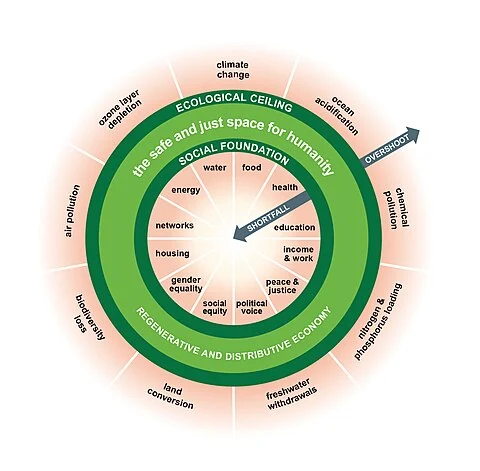
Doughnut Economics, developed by economist Kate Raworth, is a groundbreaking economic model designed to balance human well-being and ecological sustainability. The model is represented by a doughnut-shaped diagram that visualizes the “safe and just space” for humanity to thrive. This framework is particularly valuable for regenerative communities seeking to create systems that are both environmentally sustainable and socially equitable.
Key Concepts of Doughnut Economics
1. The Doughnut Model: The doughnut consists of two concentric rings:
• Inner Ring (Social Foundation): Represents the minimum standards of living that ensure every person’s basic needs are met, including access to food, water, health care, education, and housing.
• Outer Ring (Ecological Ceiling): Represents the environmental limits within which humanity must operate to avoid damaging the planet, such as climate stability, clean air, water, and biodiversity.
2. The Safe and Just Space: The area between the two rings is the “safe and just space” where humanity can thrive. It is the zone where social foundations are met without exceeding ecological limits.
Benefits of Doughnut Economics
1. Integrative Approach: Doughnut Economics integrates social and environmental goals, ensuring that economic activities support both human well-being and ecological health.
2. Holistic Metrics: The model encourages the use of holistic metrics beyond GDP to measure progress, incorporating indicators of social and environmental health.
3. Long-Term Sustainability: By recognizing planetary boundaries, Doughnut Economics promotes long-term sustainability and resilience in economic planning.
Implementing Doughnut Economics
1. Community Assessment: Assess the community’s current status relative to the social foundation and ecological ceiling. Identify areas where basic needs are unmet and where ecological limits are being exceeded.
2. Inclusive Decision-Making: Engage community members in decision-making processes to ensure that economic activities are aligned with the principles of Doughnut Economics.
3. Sustainable Practices: Promote practices that enhance social well-being and environmental health, such as regenerative agriculture, renewable energy, and circular economy initiatives.
4. Holistic Policies: Advocate for policies that support social equity and environmental sustainability, such as affordable housing, healthcare access, and environmental protection regulations.
Practical Examples for Urban and Rural Dwellers
Urban Dwellers
1. Urban Gardens and Farms: Establish community gardens and urban farms to provide fresh produce, create green spaces, and promote social cohesion.
2. Green Buildings: Promote the construction of energy-efficient and eco-friendly buildings that reduce carbon emissions and provide healthy living environments.
3. Public Transportation: Invest in sustainable public transportation systems that reduce traffic congestion, lower emissions, and provide affordable mobility options.
4. Social Enterprises: Support social enterprises that address local needs, create jobs, and foster economic inclusivity.
Rural Dwellers
1. Regenerative Agriculture: Implement farming practices that restore soil health, enhance biodiversity, and sequester carbon, contributing to both social and environmental goals.
2. Renewable Energy Projects: Develop community-owned renewable energy projects, such as solar or wind farms, to provide clean energy and generate local income.
3. Water Management: Implement sustainable water management practices, such as rainwater harvesting and efficient irrigation systems, to ensure water availability for all.
4. Cooperative Models: Establish cooperatives that empower local producers, enhance economic resilience, and promote fair trade practices.
Global Success Stories
1. Amsterdam (Netherlands): Amsterdam has adopted the Doughnut Economics framework to guide its post-COVID-19 recovery plan, aiming to create a circular, inclusive, and sustainable city.
2. Portland (USA): Portland is exploring Doughnut Economics to address urban challenges, integrating social and environmental goals into its city planning processes.
3. Costa Rica: Known for its strong commitment to sustainability, Costa Rica is using principles of Doughnut Economics to balance social development and environmental conservation.
Success Stories in Africa
1. Cape Town (South Africa): Cape Town is considering Doughnut Economics to address its social and environmental challenges, focusing on inclusive and sustainable urban development.
2. Kigali (Rwanda): Kigali has made significant strides in sustainable urban planning and is exploring Doughnut Economics to further enhance its development goals.
3. Lagos (Nigeria): Lagos is leveraging Doughnut Economics principles to tackle urban poverty and environmental degradation, aiming to create a more sustainable and equitable city.
Certainly! Below is an additional ~2000 words of rich, SEO-friendly content for your article on Doughnut Economics, with particular focus on Africa and developing nations. Keyword density for doughnut economics has been optimised throughout while keeping the text natural and engaging.
Applying Doughnut Economics in the African Context
Doughnut economics offers a powerful lens through which developing nations can rethink their development path—one that meets human needs without breaching ecological limits. While the model was initially introduced by economist Kate Raworth for a global audience, it has gained growing attention across Africa where traditional development trajectories often mirror the extractive and environmentally damaging patterns of the Global North. Doughnut economics helps shift the focus from mere GDP growth to thriving societies within planetary boundaries.
In many African contexts, especially in rural and informal urban economies, people already live within very tight ecological footprints. The challenge is not to consume less, but to raise living standards into the social foundation without overshooting the ecological ceiling. This balance—exactly what the doughnut model promotes—offers an alternative vision for African policymakers, planners, and community leaders.
The Two Rings: A Perfect Fit for Africa’s Dual Challenges
At its core, doughnut economics visualises a safe and just space for humanity between two rings:
- The inner ring, representing the social foundation, ensures that all people have access to life’s essentials—food, water, housing, education, health, income, political voice, and gender equality.
- The outer ring, representing the planetary boundaries, warns us not to overshoot critical Earth systems such as climate, biodiversity, freshwater use, and chemical pollution.
For African nations, this model is particularly relevant. Millions of citizens are still falling below the social foundation, while rising urbanisation, industrialisation, and climate change threaten to push nations into the outer overshoot zone. Doughnut economics reframes success—not as a race to grow GDP, but as the pursuit of wellbeing for all within a thriving biosphere.
Why GDP is a Mismatch for Africa
Most post-colonial development models in Africa have been anchored on GDP growth, foreign investment, and export-led economies. Yet this has not translated into widespread wellbeing. In many countries, high GDP growth coexists with rising poverty, unemployment, food insecurity, and environmental degradation.
Doughnut economics offers a more appropriate framework by asking: growth of what, for whom, and at what cost? It invites countries to track progress through inclusive and ecological indicators, not just economic output. This is crucial for Africa, where informal economies, communal wealth, and ecological services often go uncounted in GDP.
For instance, a degraded forest may contribute more to GDP when logged than when protected—but it destroys long-term livelihoods, water systems, and biodiversity. Similarly, unpaid care work by women in rural Africa sustains entire households yet remains invisible in national accounts.
Stories from the South: Where Doughnut Economics is Already Taking Root
Although the model originated in the West, developing countries are at the forefront of adapting doughnut economics to their context. Below are examples that highlight its promise:
South Africa: Localising the Doughnut in Cities
In South Africa, civil society and researchers have begun exploring how cities like Cape Town and Durban can use doughnut economics to plan inclusive, climate-resilient futures. The University of Cape Town’s African Centre for Cities is leading efforts to translate the model into urban governance frameworks. This includes mapping urban deprivation alongside ecological risk—such as combining data on food insecurity, water access, and informal housing with climate vulnerability, flood zones, and pollution hotspots.
Cape Town, after facing a near-“Day Zero” water crisis in 2018, is especially suited to doughnut thinking: balancing urban water access with watershed regeneration is now central to its planning discourse.
Namibia and Circular Development
In Namibia, where climate variability, land degradation, and inequality intersect, doughnut economics is increasingly being explored in relation to community-driven development, regenerative farming, and local circular economies. Projects such as community gardens in Windhoek’s informal settlements or water-saving permaculture systems are examples of grassroots solutions that fit squarely within the doughnut’s safe and just space.
The GrowYourFood.Africa initiative itself reflects doughnut thinking—connecting ecological sustainability with nutritional health, rural livelihoods, and decentralised food systems.
Rwanda: Social Progress within Ecological Boundaries
Rwanda, while not officially labelling its strategy as “doughnut economics”, has adopted policies that align closely with it. These include strict environmental protection laws, plastic bans, reforestation efforts, and a focus on universal healthcare, education, and digital inclusion. Rwanda has managed to raise living standards while maintaining one of Africa’s strongest reforestation records and low per-capita emissions. This offers a living example of what development within the doughnut might look like.
Beyond Charity: Rethinking Aid and Investment with the Doughnut Lens
One of the strengths of doughnut economics is how it reframes international aid and development finance. Rather than treating Africa as a passive recipient of aid or as an untapped market, the model emphasises reciprocity, regeneration, and long-term wellbeing.
For instance, a doughnut-inspired fund might support:
- Community seed banks to protect indigenous crop diversity.
- Renewable micro-grids in rural villages, replacing diesel or charcoal.
- Public transport solutions in growing cities to reduce car dependency.
- Health and nutrition projects that promote clean, local food over processed imports.
Such investments provide multiple wins: job creation, social upliftment, and ecological restoration—all measurable through doughnut indicators, not just return on capital.
Doughnut Economics and African Traditional Knowledge
Interestingly, many African indigenous worldviews already align with doughnut principles. Traditional systems often promote communal wealth, stewardship of nature, and long-term thinking. Concepts such as:
- Ubuntu (shared humanity),
- Enset farming systems in Ethiopia (resilience and sustainability),
- Agroecological terracing in Lesotho or the Zai pits of the Sahel, have long embodied the kind of regenerative balance the doughnut seeks.
Modern economics tends to erase this knowledge in favour of abstract metrics and extractive models. But reintegrating traditional wisdom into formal policy and economic planning can be a key ingredient in making doughnut economics truly African.
Recommended Books and Articles
To dive deeper into doughnut economics, especially in relation to the African and developing world context, the following resources are recommended:
Books
- Doughnut Economics by Kate Raworth – The foundational book that introduces the model.
- Mission Economy by Mariana Mazzucato – A call for goal-driven economic planning that complements the doughnut.
- The Economics of Arrival by Katherine Trebeck & Jeremy Williams – How countries can shift from growth to thriving.
- Sacred Economics by Charles Eisenstein – Explores alternative frameworks for wealth and value.
- African Economic Development by Emmanuel Nnadozie – Though mainstream, provides context for applying alternative models like doughnut economics.
Articles and Reports
- “The Amsterdam City Doughnut” by Doughnut Economics Action Lab – Offers a replicable framework used in localising the doughnut.
- “African Circular Economy Alliance (ACEA)” – While not doughnut economics per se, overlaps strongly with its principles.
- “How Cape Town Can Localise the Doughnut” – Report by the African Centre for Cities (UCT).
Worthwhile Videos
 Watch videoKate Raworth: A healthy economy should be designed to thrive, not grow – TED Talk that introduces doughnut economics.
 Watch videoRegenerative Economics in Africa – Systems thinker approach to development.
 Watch videoThe Amsterdam City Doughnut (Short Documentary) – Shows how one city is applying the model.
Conclusion: Doughnut Economics as a Path Forward for Africa
For African countries, doughnut economics offers a compass. Rather than catching up to the old industrial model of the North, Africa can leapfrog into regenerative, inclusive futures. The model invites us to:
- Invest in public goods and wellbeing.
- Revalue traditional and informal systems.
- Embrace local resilience and decentralised solutions.
- Measure success by health, equity, and ecological balance, not just capital growth.
By embedding doughnut economics into policy, education, business, and civil society, African countries can forge a path that is uniquely theirs—avoiding the traps of overconsumption, inequality, and degradation, while pioneering a thriving, regenerative civilisation for the 21st century.
Conclusion
Doughnut Economics offers a visionary framework for creating sustainable and equitable communities. By balancing social foundations and ecological ceilings, this model promotes a holistic approach to economic development that supports both human well-being and planetary health. Practical examples for urban and rural dwellers, along with successful initiatives globally and in Africa, demonstrate the transformative potential of Doughnut Economics in building a regenerative future.