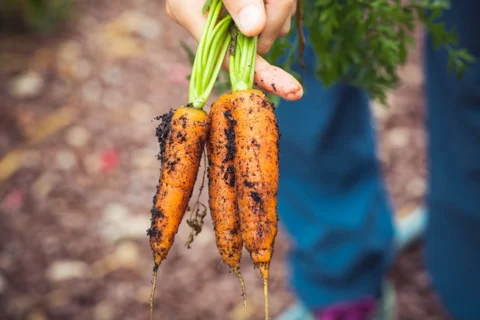
A short row of carrots can supply useful food without taking over a small garden. The important work happens early: choose a root shape that fits your soil, establish an even stand and keep the growing roots supplied with water.

At a glance
- Botanical name: Daucus carota subsp. sativus. The edible harvest is the swollen root.
- Sow directly into the final bed or container. Choose short-rooted types where usable soil is shallow.
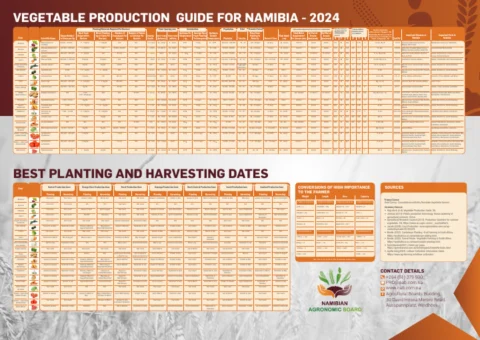
- The NAB chart gives 1–1.5 cm sowing depth, 3–8 cm within rows and 20–30 cm between rows, with 70–120 days to maturity. Adjust to the cultivar and intended harvest size.
NAB production reference — these are planning ranges, not a guaranteed harvest date.
Namibian climate and microclimate
Plan the first sowing for a period when you can keep the seed row moist and protect it from drying wind. A sunny inland bed, a shaded courtyard and a foggy coastal garden need different routines. Walk the intended spot in the afternoon: reflected heat from paving or metal may matter more than the general weather forecast.
Compare planting dates with a grower in your own region. UK instructions saying carrots rarely need water depend on a very different rainfall setting; do not turn that statement into a Namibian irrigation rule. In a container, check the root zone as well as the surface. Our practical recommendation is to start with one manageable row before sowing a whole bed.
Prepare the bed and choose seed
Use a sunny, well-drained position with soil loose enough for the chosen root length. Remove stones and break up compacted layers where necessary. Short or round varieties give another option where a deep bed is impractical; a container must still drain freely and have room for the mature roots. Recent heavy manure applications and physical obstructions can lead to forked roots. GrowVeg: soil and variety choices.
Check the seed label, storage history and sowing instructions. Prepare a fine surface without turning the whole bed into dust. Use soil-test information to decide on fertiliser: vigorous leaves alone are not the goal. Utah State University emphasises avoiding both water and nutrient stress during root growth. USU carrot guide.
Sow, establish and thin
Mark a shallow row and sow thinly, cover and settle the surface gently. Water with a fine flow that does not wash seed into heaps. Carrots can be slow to emerge, so label the row and continue checking it rather than immediately resowing on top. Deep dry soil underneath a damp-looking crust can still leave seedlings struggling.
When seedlings are established, thin crowded patches to the chosen spacing and weed gently around them. Closely packed plants compete for root space; removing a few early is usually easier than separating a tangled harvest. Avoid moving established carrot seedlings around as if they were cabbage transplants. University of Minnesota: establishment and care.
Water, mulch and inspect
Keep growth reasonably steady. Sudden wetting after a dry spell can contribute to splitting. Mulch between established rows where useful, but do not bury tiny emerging seedlings under coarse material. A drip line is only helpful if its wetting pattern reaches the actual row; check several spots rather than trusting the timer.
For a first trial, write down how many litres you apply to a measured bed, alongside weather and soil-moisture observations. This creates your own starting record instead of borrowing a fixed daily volume from a different soil. Record failed emergence too: it is a water and seed cost even if nothing reaches the kitchen.
Troubleshooting before treatment
- Gaps in the row: examine seed age, drying, crusting and depth before blaming an insect.
- Forked roots: inspect stones, compaction and root injury. A misshapen sound carrot may still be useful food.
- Split roots: review changes in water availability and harvest timing.
- Stunted plants or distorted roots: take photographs and a sample for local diagnosis. The NAB chart includes root-knot nematodes among carrot concerns; leaf symptoms alone do not identify them.
The original overseas text emphasised carrot fly. Its presence on a UK pest list is not evidence that it caused damage in your garden. Identify the problem before choosing a treatment.
Harvest and use
Lift a sample when the root looks useful rather than waiting for every carrot to become large. Loosen firm soil with a fork placed away from the roots, then handle the crop without bruising it. Remove foliage for storage and separate damaged roots for prompt use. Cool storage helps maintain quality; a hot shed is not equivalent to the cold storage described in northern-climate guides. RHS harvesting and storage guide.
For a household garden, stagger small sowings only while the season and water supply remain suitable. Compare usable harvest with seed, water and time spent. A smaller crop eaten fresh can be more worthwhile than a large crop that cannot be stored.
Seed saving and local learning
Carrots normally flower in a later growth cycle and can cross-pollinate. If saving seed, plan isolation and select healthy plants rather than simply keeping the first early-flowering specimen. Start by learning to produce reliable eating roots, then add a small seed-saving trial with appropriate guidance.
No carrot-specific firsthand growing report was identified in the recovered mailbox text reviewed for this update. Add your own observations: which sowing month worked, what helped emergence, and how the crop performed in your particular soil.
Watch, understand, adapt
 Watch video▶ Growing Carrots from Sowing to Harvest — GrowVeg.
Country and context: UK-based publisher; the exact filming site is not confirmed. Watch the bed preparation, thin sowing and lifting techniques. Rainfall, summer heat and pest assumptions differ from Namibia. Use the demonstration for technique, and the Namibian production chart and nearby growers for season and variety choices.
Earlier video links
 Watch videoOriginal carrot-growing video remains a further resource: it is also referenced in a US SARE project report. The other
  Watch videooriginal video link could not be independently verified and is retained for continuity, rather than as the recommended demonstration.
Visual references from the original guide
Earlier illustrations remain available here; their filming or growing location is not established. The credited main photograph above is the illustration for this revised guide.


Keep exploring
- Vegetable overview — choose your next crop
- Beetroot
- Bulb onions
- Map your garden microclimate
- Drip irrigation
Have you tried this in Namibia? Share your region, variety, planting date, soil, water, harvest and what you would change. Local successes and failures both help the next grower.
Documents to read or download