
Tamarix usneoides is a southern African tamarisk associated with dry and saline environments. It deserves a place in local tree learning, but the name “tamarisk” also covers introduced species and hybrids. Identification comes before a planting recommendation.
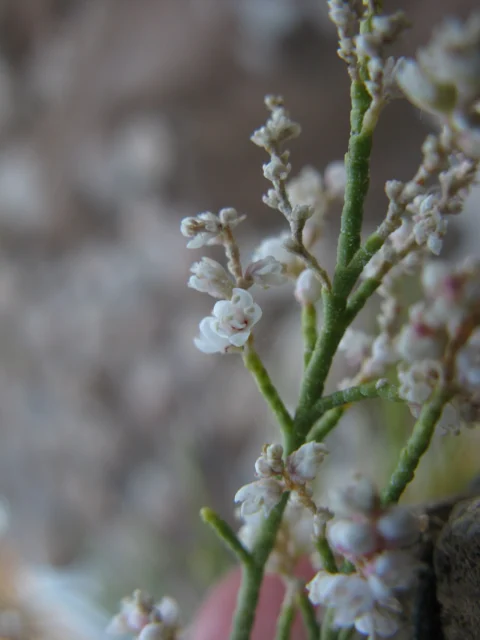

From the Namibian discussions
The restored collection included a document specifically named for Tamarix usneoides. That establishes the topic’s local interest, not the identity of every tamarisk growing nearby. Keep nursery provenance and a botanist’s identification with any material offered for planting.
Separate native plants from lookalikes
SANBI records T. usneoides as indigenous in southern Africa. Research on southern African tamarisks distinguishes it from introduced T. chinensis and T. ramosissima and documents hybridisation. A photograph of fine foliage is not enough to settle that distinction. Flowers and specialist examination may be needed.
Start with the site and purpose
- Identify whether the aim is habitat, shelter or rehabilitation of a saline site. Do not assume that salt tolerance means the tree removes a salinity problem.
- Record the source of planting material and ask whether the identity has been verified.
- Map drains, watercourses and neighbouring land before planting. Avoid spreading unidentified tamarisks along waterways.
- Discuss the proposal with a local nursery, botanist or restoration adviser familiar with the area.
Use a small, observable planting
If the species and site are appropriate, begin where survival, water use and seedling spread can be monitored. Label plants and photograph their condition through dry and wet periods. Record irrigation in litres rather than describing a planting as “no water” when it receives occasional watering or runoff.
Watch what changes around it
A shelter planting changes shade, litter and access as it grows. Observe nearby vegetation and any new recruits outside the intended area. Keep a record of soil or water salinity when it is relevant to the project. Healthy foliage alone does not demonstrate that the soil has improved for vegetables.
Namibian climate and microclimate
A saline river margin and a dry urban yard are different settings. Wind, groundwater access and irrigation-water quality may explain survival more than the rainfall total. Do not copy a wetland planting into a small food bed.
Your first practical step
Photograph a known local specimen and ask for confirmation of its identity. Keep that record before sharing seed or cuttings.
Watch and adapt
 Watch videoWatch: Build a Nursery & Grow Trees
Publisher: Community Forests International
Country and context: Exact filming country not confirmed; Swahili with English subtitles.
A general seedling-care lesson, also catalogued by World Agroforestry. It is not a species-specific growing demonstration.
The nursery film teaches organisation and seedling care. It does not identify Tamarix species or establish a planting recommendation for a saline Namibian site.
Keep exploring
- Invasive Species in Namibia – Threat or Opportunity?
- How Windbreaks Can Save Water, Soil and Crops in Harsh Climates
- Water-Efficient Plant Selection
Sources and further reading
Have you tried this in Namibia? Share the site conditions, method and result—including what did not work—with the Living Earth community. Local observations help the next person adapt the idea.