
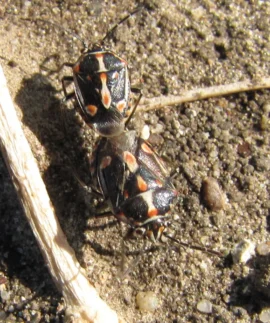
Bagrada hilaris is a small shield bug that can damage brassicas such as cabbage, kale and mustard. Young plants deserve close attention because feeding at the growing point can affect the whole crop.

From the Namibian discussions
A Namibian grower reported that Bagrada problems declined as soil conditions improved and that the bugs all but disappeared after intercropping brassicas with garlic chives and red and white onions. They had not seen the pest for years. This is valuable local experience, worth trying and documenting; it does not establish which change caused the result or guarantee the same outcome elsewhere.
Recognise the pest and injury
UC IPM describes the bug and its association with brassica crops, including injury to seedlings and growing points. Confirm the insect rather than assuming every patterned bug is Bagrada. Photograph adults or nymphs and the fresh injury together.
Give young plants extra attention
- Inspect transplants before bringing them into the garden.
- Check seedlings and growing points regularly, especially when new injury appears.
- Record the number of affected plants and whether nearby brassicas or weeds also host bugs.
- Where suitable, use well-fitted exclusion mesh over clean plants, ensuring that heat, light and watering remain manageable. Check that pests have not been enclosed inside.
Turn the onion observation into a useful trial
Try a small mixed planting alongside a comparable brassica-only area if pest pressure and crop value allow. Keep brassica variety, planting date and watering similar. Record onion spacing, soil changes and bug observations, then compare usable harvest. Even a simple record helps another gardener understand what “intercropped” meant in practice.
Avoid a single-method promise
A companion plant should not replace inspection. UC IPM notes that Bagrada can use several hosts, so rotation alone may not remove the problem. If losses are serious, seek locally appropriate pest advice. Maintain habitat for beneficial insects without allowing an unmanaged pest reservoir beside vulnerable seedlings.
Namibian climate and microclimate
Warm sheltered conditions, nearby host vegetation and the timing of brassica establishment can change pressure. Shade and mesh can also change temperature around seedlings, so check the plants rather than assuming protection is harmless.
Your first practical step
Photograph a confirmed bug and set up a short observation record. If trying onions, describe the layout and water regime when sharing the result.
Watch and adapt
 Watch videoWatch: Beneficial Insects and Natural Enemies
Publisher: University of California IPM
Country and context: USA; California context.
A supporting lesson on beneficial insects; identify the species actually present in your Namibian garden.
Use the film to recognise the role of beneficial insects. It does not prove the Namibian onion-intercropping observation or provide a locally registered treatment.
Keep exploring
Sources and further reading
Have you tried this in Namibia? Share the site conditions, method and result—including what did not work—with the Living Earth community. Local observations help the next person adapt the idea.