
Trees influence water through their roots, leaves, shade and place in the wider landscape. These connections help explain both the value of restoring appropriate vegetation and the need to consider water trade-offs. Planting trees is not a guarantee of more rain at the planting site.

From the Namibian discussions
The Namibian collection shared a video titled How Trees Make Rain: Science Now Proves It. The title raises an important topic, but the saved link is not a measurement of rainfall caused by tree planting in Namibia. Use it to start a discussion about scale, water supply and suitable ecosystems.
Follow the water through a planted place
Rain can be intercepted by leaves, reach the ground, run off or enter the soil. Roots take up water, and plants release water vapour through transpiration. NASA’s water-cycle resources explain this movement between land and atmosphere. Shade and ground cover can also change the conditions close to the soil.
A cooler patch under a tree is a local observation. Increased infiltration, groundwater recharge, streamflow and regional rainfall are different outcomes and need different measurements. Avoid treating one visible benefit as proof of all the others.
Keep local and regional effects distinct
Water vapour released from vegetation can be transported downwind as part of atmospheric moisture circulation. Whether and where rain falls also depends on winds, available moisture and atmospheric conditions. A garden or tree belt cannot be assigned a predictable rainfall return from a general water-cycle explanation.
CIFOR-ICRAF discusses managing forests with both downstream and downwind water in mind. This broader perspective also exposes trade-offs: trees use water, and a change that improves one part of the system may reduce water available elsewhere. Ask which outcome and which scale a claim refers to.
Restore the appropriate ecosystem
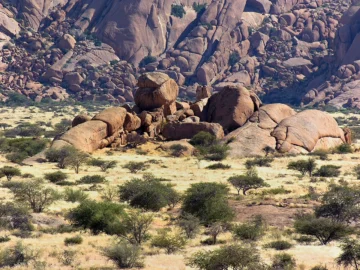
Begin with the site’s vegetation, soils and land-use history. An open grassland is not necessarily a damaged forest waiting to be planted. In Namibia, protecting suitable grass, shrubs and existing trees may be more appropriate than increasing tree density everywhere.
Select species and densities for a clear purpose such as shade, food, wind protection or restoring a degraded habitat. Consider mature size, water demand, invasiveness and access for people and animals. Keep valuable open habitat and water pathways in the design rather than filling every available space with trees.
Make an establishment and water budget
- Map existing vegetation, runoff routes and places where planting is justified.
- Estimate the water and protection needed through establishment and dry periods.
- Plan mulch, guards and maintenance with the people responsible.
- Start at a scale you can maintain and record survival before expanding.
For larger catchment or river projects, assess effects with appropriate specialists and neighbouring users. Do not redirect runoff or establish thirsty plantings near shared water resources on the assumption that future rainfall will repay the water used.
Measure the benefits you can actually observe
Track survival, canopy growth, usable products, irrigation and ground cover. If comfort is the goal, take comparable temperature observations in shaded and unshaded places at consistent times. If erosion is the concern, use safe fixed photo points and records after rain.
Keep rainfall records, but do not attribute a wetter year to a recent planting without a much stronger study. A project can succeed by providing shade, fruit, habitat or better soil protection even when no rainfall increase can be demonstrated. Share those concrete benefits and the work and water they required.
Namibian climate and microclimate
Namibia’s fog-influenced coast, central highlands, northern woodlands and arid southern landscapes have different water balances. Sheltered courtyards and runoff receiving areas may support trees that would struggle on an exposed slope. Fit planting to these conditions instead of copying a humid forest model.
Your first practical step
Choose one clear planting objective and one suitable site. Record the establishment water and the benefit you intend to measure, without budgeting for an assumed increase in rain.
Watch and adapt
 Watch videoWatch: How Trees Make Rain: Science Now Proves It | More Rain, Better Farms
Publisher: Learning from Nature
Country and context: Filming country not confirmed; broad landscape-water discussion.
This is the film shared in the saved discussion. Its title is a publisher claim, not a guarantee that planting trees will increase rainfall at a particular site.
The shared film is a broad educational presentation, not a Namibian field trial. Its filming country was not confirmed. Compare its claims with the NASA and CIFOR-ICRAF resources and keep local shade effects separate from regional rainfall.
Keep exploring
- Trees – Start here
- Agroecology in Africa
- Rainwater Harvesting in Arid Regions: Practical Solutions for Water Security in Southern Africa
- Water-Efficient Plant Selection
Sources and further reading
- NASA: the water cycle
- CIFOR-ICRAF: forests, downstream water and downwind water
- CIFOR-ICRAF: managing forest–water relationships
Have you tried this in Namibia? Share the site conditions, method and result—including what did not work—with the Living Earth community. Local observations help the next person adapt the idea.