
Before spending money on a pond liner, distinguish evaporation, leakage and overflow. Then test the proposed sealing material at a small scale. A material that briefly holds water in a bowl may not remain watertight through drying, roots and repeated filling.
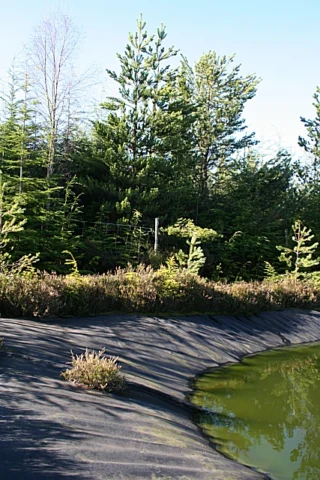

From the Namibian discussions
A Namibian discussion wondered whether pap or porridge could seal a pond in the way some clay vessels are sealed. It was explicitly a question, not a successful pond trial. Keep the inventive idea in the record without presenting food starch as an established long-term liner.
Measure the loss
Mark the water level and record additions, withdrawals, rain and overflow. A nearby open reference container can help you think about evaporation, although its temperature and exposure will not perfectly match the pond. Look for wet patches outside the basin and inspect accessible fittings.
Match a liner to the site
NRCS guidance treats compacted soil and manufactured liners as designed systems. Suitability depends on soil properties, installation and protection. A clay-rich material needs appropriate preparation; simply scattering a little clay into sand is not the same as constructing a compacted liner.
Try a contained comparison
- Use small perforated inner containers over separate watertight catch trays. Apply the proposed liner inside each inner container so seepage can be collected and measured.
- Record the material, thickness and preparation method.
- Compare collected seepage with an untreated container of the same design; use a separate watertight open container to help assess evaporation.
- Observe more than the first fill, including a drying and refilling cycle where appropriate.
Plan the whole pond
Include safe access, overflow, animal protection and maintenance. If the pond will hold fish or food-production water, check material compatibility. For a substantial pond or embankment, obtain competent site-specific design advice before excavation. A household material test is only an early screening step.
Namibian climate and microclimate
High evaporation can disguise a successful liner, while drying cracks can undo an initially good seal. Namibia’s scarce water makes small tests particularly worthwhile. Consider whether a covered tank serves the intended purpose more efficiently than an open pond.
Your first practical step
Keep a short water-level record and check fittings before purchasing or improvising a liner.
Watch and adapt
 Watch videoWatch: How (and why) to FIND YOUR WATERSHED
Publisher: Andrew Millison
Country and context: Exact filming country not confirmed.
A watershed-reading lesson. Use Namibian maps to locate your own catchment and confirm local drainage on foot where safe.
The watershed lesson helps locate a pond within its water source and overflow route. It is not a pond-lining construction specification.
Keep exploring
- Building/sealing earth dams
- Rainwater tanks: compare roof yield with actual demand
- Natural Swimming Pool
Sources and further reading
Have you tried this in Namibia? Share the site conditions, method and result—including what did not work—with the Living Earth community. Local observations help the next person adapt the idea.