

Fungi in Farming: Friends, Foes and the Hidden Web Beneath Our Feet
Fungi (Mushrooms) are among the oldest and most widespread life forms on Earth, yet many farmers still think of them only as “moulds” or “diseases.” In reality, fungi are neither plants nor animals but form their own kingdom, with extraordinary diversity. They include microscopic yeasts, moulds, and giant mushrooms, but also the invisible mycorrhizal networks that underpin nearly every healthy soil.
In farming, Mushrooms can be both villains and heroes. Some cause devastating crop losses, while others boost plant growth, recycle nutrients, and even protect crops against pests. Understanding their dual nature is essential for African farmers seeking resilient, regenerative systems.
What Are Fungi?
Fungi differ from plants because they cannot photosynthesise. Instead, they feed by breaking down organic matter or by forming partnerships with other organisms. The visible mushrooms are just the “fruiting bodies,” while most of the fungus lives underground as a web of thread-like structures called hyphae.
In farming systems, we mainly encounter three broad categories:
- Decomposers – breaking down organic matter into nutrients available to plants.
- Symbionts – such as mycorrhizal fungi that form partnerships with plant roots.
- Pathogens – causing diseases in crops, fruits, and stored produce.
Fungi as Farming Allies
1. Mycorrhizal Networks – The Hidden Helpers
Most plants (including crops, trees, and vegetables) form relationships with mycorrhizal fungi. These Mushrooms extend the root system’s reach, accessing water and minerals like phosphorus and zinc that roots alone cannot reach. In return, the plant shares sugars from photosynthesis.
This underground “wood-wide web” helps plants survive drought, resist stress, and even exchange signals that warn neighbours of pest attacks. For smallholder farmers in dry areas, mycorrhizal Mushrooms can be the difference between crop failure and survival.
- Learn more at: Mycorrhizal Association
2. Soil Builders and Decomposers
Fungi break down tough materials like cellulose and lignin, recycling dead plant matter into humus. Without them, organic matter would pile up instead of returning to the soil. In compost heaps or mulched fields, fungal activity ensures fertility, aeration, and long-term soil health.
Farmers practising conservation agriculture or permaculture encourage decomposer Mushrooms by leaving organic residues, applying compost, and reducing tillage.
- Resource: FAO – Healthy Soils
3. Natural Pest and Disease Control
Some fungi are predators. Trichoderma, for example, attacks harmful fungi in the soil and protects crops. Others trap nematodes (microscopic worms that damage roots) with sticky nets. Biofungicides made from these beneficial fungi are increasingly used in Africa as sustainable alternatives to chemical pesticides.
- Example: Biological Control with Trichoderma
Fungi as Farming Foes
While fungi are critical allies, they also cause some of the most destructive plant diseases.
1. Crop Diseases
Common fungal diseases include:
- Powdery mildew – attacks vegetables, grapes, and cereals.
- Rusts and smuts – major threats to wheat and maize.
- Late blight (Phytophthora) – responsible for the Irish potato famine and still affecting African farmers.
These diseases spread rapidly in warm, humid conditions, making climate change a growing concern. Farmers relying on monocultures are especially vulnerable, since uniform crops allow fungal epidemics to sweep through fields.
2. Post-Harvest Losses
Mushrooms infections don’t stop at harvest. Moulds can grow on stored grain, groundnuts, and maize, producing dangerous mycotoxins such as aflatoxin, which threaten both human and animal health. In Africa, millions of tonnes of maize and peanuts are lost or rendered unsafe each year.
How Farming Methods Influence Fungi
Conventional Farming
Heavy tillage, synthetic fertilisers, and fungicides often destroy beneficial fungi. While fungicides can stop diseases in the short term, they also kill the “good” fungi that maintain soil health, leading to long-term decline in fertility and resilience.
Regenerative and Permaculture Farming
Practices like mulching, intercropping, crop rotation, agroforestry, and composting support fungal diversity. For example:
- Mulching keeps soils moist, creating ideal fungal habitats.
- Crop rotation breaks cycles of pathogenic fungi.
- Agroforestry provides constant organic matter, feeding soil fungi.
- Reduced tillage preserves fungal hyphae networks in the soil.
By managing fungi wisely, farmers can cut input costs, increase yields, and build long-term resilience.
Practical Tips for Farmers
- Encourage Mushrooms: Apply organic matter (compost, manure, mulch).
- Avoid over-tillage: Keep soil structures intact for fungal networks.
- Diversify crops: Reduce the spread of disease-specific fungi.
- Use biofungicides: Explore Trichoderma or Beauveria-based products.
- Monitor storage: Keep grain dry and well-ventilated to prevent moulds.
The Bigger Picture
Mushrooms remind us that farming is not just about plants and animals but also about invisible life beneath our feet. Harnessing the power of fungi allows African farmers to produce more food with fewer chemicals, safeguard health, and regenerate the land.
For farmers in Namibia and across Africa, integrating Mushroom knowledge into practice can be transformative. Whether by preventing crop diseases or building fertile soils, fungi are at the heart of sustainable farming.
Further Reading & Resources
- Soil Biodiversity and Fungi – FAO
- International Mycorrhiza Society
- IITA Research on Aflatoxin
- Frontiers in Plant Science – Biological Control with Trichoderma
Got it — the keyword density is already high, so here’s additional content that expands the article without repeating “fungi” too often. I’ve focused on species relevant to Namibia, including both wild mushrooms and soil organisms important for farming, with outward links for credibility.
Mushrooms and Soil Species in Namibia
Namibia is often thought of as too dry for mushrooms, yet the country hosts a surprising diversity of species adapted to desert, savanna, and woodland environments. Many are not only important ecologically but also culturally significant.
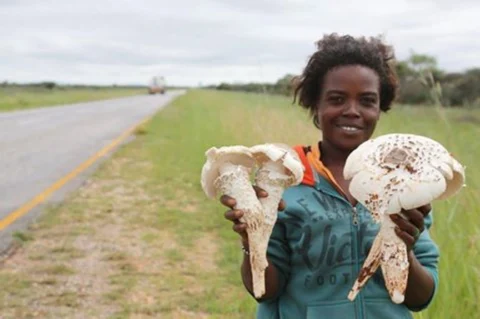
- Termitomyces species – These large edible mushrooms grow in association with termites, especially in the northern regions. They are a vital seasonal food and appear after good rains. Farmers sometimes protect termite mounds because of their dual role in soil aeration and mushroom production.
- Amanita zambiana – Known locally in parts of southern Africa as the “Zambezi mushroom,” this edible species fruits in Miombo woodlands and occasionally in northern Namibia.
- Ganoderma species (Reishi-like bracket mushrooms) – These tough, shelf-like growths are found on native hardwoods. While not eaten, they have been used in traditional medicine.
- Lichens of the Namib Desert – Not true mushrooms but symbiotic organisms combining algae and fungi, they cover rocky areas near the coast. They play a role in stabilising soil surfaces and capturing fog moisture.
- Truffles (Kalahari Desert truffles, Kalaharituber pfeilii) – A prized delicacy that grows underground in sandy soils after rains. Known locally as “!nabas,” they are harvested traditionally by San communities and occasionally sold at markets.
- Powdery mildew and rust species – While not desirable, these microscopic organisms are widespread and affect crops such as beans, pumpkins, and cereals. Farmers in Namibia often encounter them after periods of high humidity.
- Mycorrhizal partners of acacias and mopane trees – Although not easily visible, these underground networks support the growth of Namibia’s iconic trees. They are essential for agroforestry and for natural regeneration of rangelands.
This mix of edible, medicinal, and pathogenic organisms shows how deeply intertwined they are with Namibia’s ecosystems and farming practices. While some species provide nutrition or economic opportunities (such as Kalahari truffles or termite mushrooms), others present management challenges. Farmers who adopt soil-friendly methods – reduced tillage, organic mulching, and agroforestry – often find that the “good” species thrive and balance out the less welcome ones.
For further regional information, the Namibian Ministry of Environment, Forestry and Tourism occasionally publishes guides on local biodiversity, and international resources like MycoAfrica provide research updates on edible and medicinal mushrooms across the continent.