
Beehive fences use bees as part of an elephant-deterrent system. They are a managed coexistence approach, requiring suitable conditions for bees and continuing cooperation among people.
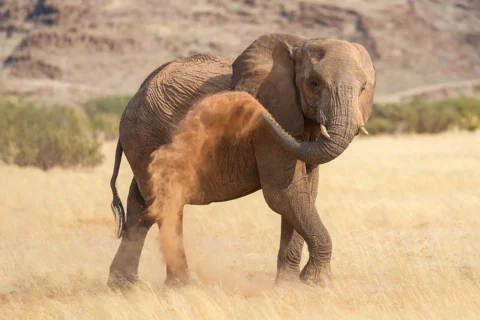
Photo: Giles Laurent · Original image · CC BY-SA 4.0. Wikimedia display-size version; no crop or content edits.

From the Namibian discussions
Elephants and bees was saved as a topic for the Namibian wiki. The recovered written message does not document a local fence installation or its success rate. Kenyan evidence offers a starting point for discussion with communities that live alongside elephants here.
What the research shows
A nine-year study near Tsavo East National Park in Kenya found substantial deterrence from beehive fences, while drought reduced hive occupation and honey production and affected performance. The study supports the method’s potential, but also shows why an empty hive or an unattended fence is not equivalent to a thriving system.
Begin with a community assessment
- Discuss elephant routes and conflict history with residents and conservation staff.
- Identify experienced beekeepers and who would maintain the system.
- Assess forage, water, hive occupancy and dry-season support.
- Consider nearby paths, homes, schools and livestock before choosing a site.
- Plan how incidents and maintenance will be recorded.
Budget for care, not only construction
Bee health, damaged components, training and agreed responsibilities belong in the plan. Honey may be a benefit, but it should not be promised as guaranteed income. Obtain a site-specific design through people experienced with the method instead of improvising from a short clip.
Measure outcomes without creating danger
Use safe observation and agreed reporting. Record approaches, breaches, crop losses, occupied hives and periods of drought. Do not approach elephants to test a fence or assume the system makes a field safe to enter during an encounter.
Namibian conditions and microclimate
Namibia’s dry seasons, local flowering and water availability may limit bee occupancy. An elephant route through a narrow landscape creates a different problem from scattered farm visits. Consider neighbours and movement corridors; protecting one plot should not simply transfer the conflict next door.
Try it locally and share what happens
Arrange a discussion with local conservation and beekeeping practitioners. Bring a map of the site and a history of incidents before seeking construction prices.
Watch, understand, adapt
How bees can keep the peace between elephants and humans
Country and context: Kenyan fieldwork presented by zoologist Lucy King at TEDWomen 2019; the talk is not filmed as a Namibian field demonstration.
Explains the research idea and its community context.
Apply it locally: Pair the introductory talk with the later drought study. Local bee forage, occupancy and safe siting need assessment before any fence is built.