
A frost cover works best as part of a routine: watch the forecast, cover vulnerable plants before the coldest period, secure the edges and check conditions again in the morning. Fabric left permanently over a crop can create new light and ventilation problems.
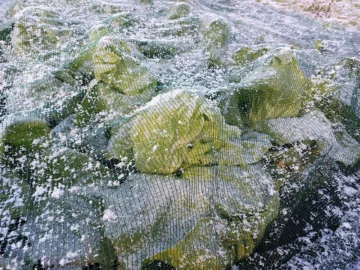
_unter_Schutznetz-6-Josef_Schlaghecken.jpg)
From the Namibian discussions
Namibian members exchanged frost-blanket supplier leads and a rule suggesting an extra layer for every 3 °C below zero. Keep the reminder to prepare early, but treat that layer rule as an unverified local heuristic. Protection depends on fabric, installation, wind, duration and the plant itself.
Prepare before the warning
Identify the plants most worth protecting and make a frame that prevents heavy material pressing on delicate growth. Keep covers dry and easy to reach. Arizona extension guidance explains how covering reduces heat loss; it does not make an unheated cover equivalent to a warm greenhouse.
Cover the useful space
- Follow the fabric supplier’s installation instructions.
- Secure the cover so it cannot blow away or whip against plants.
- Where the method depends on ground warmth, include the ground around the plant rather than wrapping only the top.
- Use a thermometer near plant height to compare covered and uncovered conditions.
Check after sunrise
Ventilate or remove covers when conditions require it, especially if the day becomes warm. Check for moisture, rubbing damage and pest access. Do not rush to remove apparently dead growth immediately after a frost; first assess the plant and obtain species-specific recovery advice.
Record the limit
Write down the forecast, actual minimum near the crop, cover type and damage. A successful mild frost does not prove protection during a longer or windier freeze. Share the details with neighbours so the experience becomes more useful than a general claim that a particular blanket works.
Namibian climate and microclimate
Cold air may settle in low parts of an inland garden, while a nearby wall changes exposure. Coastal gardens face different cold and humidity patterns. A town forecast is a starting point; your crop-level measurement shows the microclimate.
Your first practical step
Prepare one cover and a secure support frame before the next cold forecast, then record the minimum temperature beneath it.
Watch and adapt
Watch: Frost and Sun Protector
Publisher: ABC Gardening Australia
Country and context: Australia; exact filming locality not confirmed.
A removable plant-protection example. It is not a guarantee against a particular frost temperature or an enclosed-greenhouse design.
The Australian examples illustrate covering and handling. Use your own minimum temperatures and the product’s specifications, not Australian month names.
Keep exploring
Sources and further reading
Have you tried this in Namibia? Share the site conditions, method and result—including what did not work—with the Living Earth community. Local observations help the next person adapt the idea.