
Jackalberry, Diospyros mespiliformis, is a substantial indigenous African tree with shade and fruit value. It belongs in a long-term landscape plan. A sheltered, adequately moist site is a different proposition from planting it in a small, exposed water-limited garden.

From the Namibian discussions
Jackalberry appeared in the Namibian growers’ tree wish list, rather than in a report of successful cultivation. The next useful step is to find local trees and document their setting. Correcting the species spelling in a record also makes reliable nursery and botanical information easier to find.
Start with the mature tree
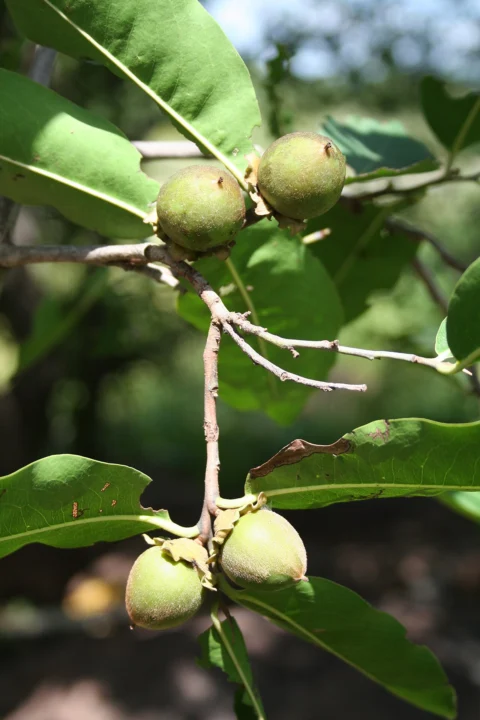
SANBI describes a tree that can reach about 25 m, with edible ripe fruit and an association with termite mounds in parts of its range. Male and female flowers occur on separate trees. A lone seedling is therefore not a guaranteed future fruit crop, and a termite mound is an ecological observation rather than a planting ingredient.
Choose the role before the position
Decide whether the main aim is shade, habitat or fruit. Mark buildings, underground services, access routes and other trees on a sketch, then discuss mature-tree space with a local nursery or arborist. A communal shade tree needs agreement about watering, protection and long-term access; it should not become one volunteer’s unspoken responsibility.
Establish carefully
- Obtain correctly identified stock with a sound root system and ask about its origin.
- Choose a position where water can reach the rooting area without prolonged waterlogging.
- Protect the plant from animals and mower or hoe damage. Keep mulch away from the stem.
- Check moisture below the surface, record water supplied and inspect after both heat and cold events. Increase the area watered as the roots establish.
Build local fruit knowledge
Observe flowering and fruit on established trees over more than one season. Record nearby trees, rain and any irrigation. A photograph of green fruit is not a ripeness guide; confirm identification and ripe-fruit use with knowledgeable local people. Keep harvest observations separate from medicinal claims about bark or other plant parts.
Namibian climate and microclimate
SANBI recommends adequate water and little frost for cultivation. That makes site selection especially important in Namibia’s colder inland areas. Shelter may reduce exposure, but it cannot turn a persistently dry or frost-prone site into the tree’s natural habitat.
Your first practical step
Find an established jackalberry and compare its setting with your site. If the differences are large, select a more locally proven shade tree.
Watch and adapt
 Watch videoWatch: Build a Nursery & Grow Trees
Publisher: Community Forests International
Country and context: Exact filming country not confirmed; Swahili with English subtitles.
A general seedling-care lesson, also catalogued by World Agroforestry. It is not a species-specific growing demonstration.
The nursery film supports basic seedling handling. Jackalberry’s eventual size, separate sexes and moisture requirements need their own planting plan.
Keep exploring
- Orchard layout: balance sunlight, wind, water and access
- Fruit trees
- Shepherd’s tree: value the Boscia albitrunca already in the landscape
Sources and further reading
Have you tried this in Namibia? Share the site conditions, method and result—including what did not work—with the Living Earth community. Local observations help the next person adapt the idea.