
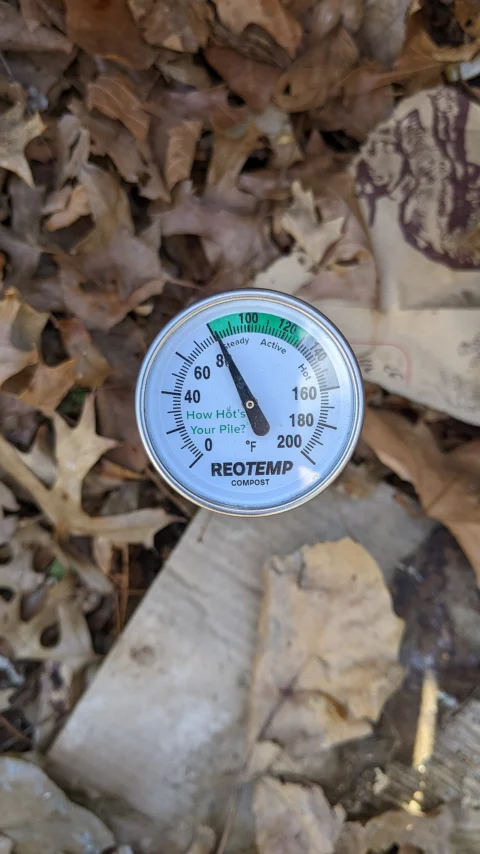
A temperature record turns a compost pile into something you can learn from. It helps show when microbial activity rises, when the pile cools and what changes after turning. A promised completion date tells you much less about what happened inside.

From the Namibian discussions
The Namibian discussions included enthusiasm for rapid Berkeley-style composting and questions about manure breaking down in beds. Keep the interest in active management, but do not assume that a warm centre or a 21-day schedule proves the whole pile is finished or sanitised.
Make observations repeatable
- Give the pile a name and record the starting materials and date.
- Use a suitable long-probe compost thermometer and follow its operating instructions.
- Measure several positions, not only the hottest centre, and record the locations.
- Note each turning, addition of water and significant change in smell or structure.
Respond to the whole pile
A reading is a clue rather than an instruction to add one ingredient automatically. Check moisture, air movement, pile size and the balance of materials. If a pile becomes excessively hot or develops a problem, follow established compost-management guidance. Keep a safe working area and do not climb on unstable piles.
Turnings need a purpose
Mixing can move cooler outer material inward and restore air, but it also takes labour and may lose moisture. Record the response after turning. This lets you compare methods honestly: a low-labour pile and a frequently turned pile have different costs even when both eventually produce useful material.
Allow a finishing stage
After active heating, assess maturity and intended use rather than rushing material into seed trays. A household temperature log is not the same as a validated pathogen-reduction process. Where compost is sold or used in a food-production programme, obtain the relevant process requirements and keep the records they require.
Namibian climate and microclimate
Hot, dry wind can dry the outside while the centre remains active. Rain can change the pile quickly in northern summer conditions. Shelter and moisture management should suit the site without sealing the pile into an airless mass.
Your first practical step
Start a one-page log with date, temperature, measuring position, moisture observation and action taken.
Watch and adapt
 Watch videoWatch: How to make great compost
Publisher: ABC Gardening Australia
Country and context: Australia; exact filming locality not confirmed.
A household composting demonstration. It is not a validated pathogen-reduction certificate for a particular manure batch.
Use the lesson for practical management ideas. Compare observations rather than expecting the same time to completion in Namibia.
Keep exploring
Sources and further reading
Have you tried this in Namibia? Share the site conditions, method and result—including what did not work—with the Living Earth community. Local observations help the next person adapt the idea.