
A large tank is only useful if enough water reaches it and the stored water serves a clear purpose. Start with roof area, rainfall, losses and demand. These simple quantities help you discuss a sensible capacity before requesting construction quotations.

From the Namibian discussions
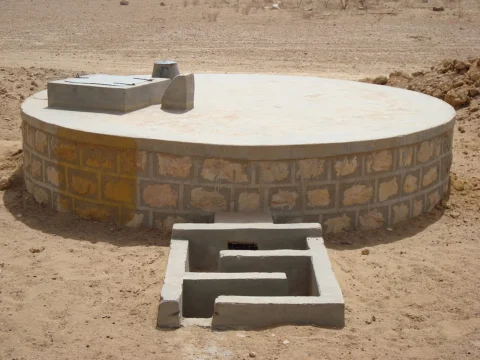
The Namibian collection shared a video about building a very large rain tank. It is an interesting example, not a structural design for another property. Keep the ambition to store rain while separating water-budget calculations from engineering, foundations and safe construction.
Estimate what the roof can collect
One millimetre of rain over one square metre represents one litre before losses. An 80 m² roof receiving 20 mm therefore intercepts 1,600 litres in theory. If you assume 80% collection for an initial example, that becomes 1,280 litres. The 80% is an assumption to investigate, not a guaranteed efficiency.
Write down demand
List the intended uses and litres per day or per irrigation. A usable reserve of 1,000 litres at 20 litres per day lasts 50 days if there is no refill and no additional loss. Real operation needs allowance for unusable volume, leakage and changing demand. Keep drinking-water needs distinct from garden-water quality requirements.
Test the dry sequence
- Use local rainfall records where available, not only the annual average.
- Track estimated inflow, demand, overflow and remaining storage through a dry period.
- Compare more than one tank capacity.
- Ask whether reducing demand or increasing useful catchment is more effective than adding storage alone.
Plan the installation separately
Have large tanks, bases and supporting structures designed and installed competently. Provide safe overflow routing, access control and appropriate screening. Never enter a tank casually. For drinking-water use, obtain a complete treatment and monitoring plan; a covered rain tank does not automatically supply potable water.
Namibian climate and microclimate
Long dry intervals and short intense storms make annual averages misleading in Namibia. Coastal rainfall may contribute little despite fog, while inland storms can overwhelm poorly sized gutters. Use the site’s actual collection system and storm behaviour.
Your first practical step
Measure the roof’s horizontal catchment area and calculate the theoretical litres from one recorded rainfall event.
Watch and adapt
 Watch videoWatch: Building a large underground rainwater tank
Publisher: Symbiosis TX
Country and context: Spicewood, Texas, USA, as described by the builder.
A practitioner construction example shared in the local collection. It is not an engineering specification for another site.
The construction example is inspiration only. Use competent local engineering for the foundation, structure and overflow of your own tank.
Keep exploring
- Rainwater Harvesting in Arid Regions: Practical Solutions for Water Security in Southern Africa
- Drought planning: agree on warning signs and actions early
- Measure dripper output before changing the watering time
Sources and further reading
- FAO: Rural structures in the tropics—water supply and rainwater storage
- Symbiosis: the featured tank project in Spicewood, Texas
Have you tried this in Namibia? Share the site conditions, method and result—including what did not work—with the Living Earth community. Local observations help the next person adapt the idea.