
A grafted fruit tree combines a fruiting variety with a rootstock. The rootstock may be grown from seed or propagated clonally. Knowing both parts helps explain size, compatibility and site suitability; a graft alone does not reveal the root system’s origin.
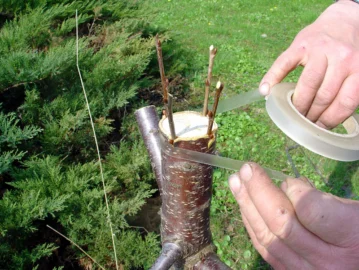

From the Namibian discussions
Namibian growers debated seed-grown and cloned rootstocks. One contributor reported that only three of about 100 apple seedlings survived a salty site and hoped to explore their potential. That is valuable local selection experience, but survival does not yet prove good fruit, a superior rootstock or general drought tolerance.
Separate the two identities
Penn State explains that fruit seedlings may differ from their parents and that grafting preserves a chosen fruiting cultivar on a compatible rootstock. Rootstocks influence tree behaviour, but their performance depends on the site. “Seedling”, “clonal” and “grafted” describe different aspects and should not be treated as opposites.
Ask the nursery useful questions
- Request the fruiting cultivar and rootstock name, not just the fruit species.
- Ask whether the rootstock is seed-grown or clonal and why it suits your soil and climate.
- Ask about mature size, support, compatibility and known limitations.
- Record the answer on a durable label and in your planting notebook.
Keep experimentation identifiable
A seedling trial can preserve diversity and reveal useful variation. Label each plant and record failures, irrigation, soil tests and eventual fruit quality. If grafting onto selected survivors, work with someone competent and keep a record of the scion added to each rootstock. Do not distribute an untested selection as a proven salt-tolerant variety.
Choose diversity deliberately
Genetic diversity can be maintained through several cultivars, species and well-recorded seedling populations. Clonal material is useful when a known trait matters; it is not automatically evidence of a fragile planting. Match the strategy to the purpose and avoid relying on a single unverified claim about taproots.
Namibian climate and microclimate
Drought, salinity, soil depth and frost are separate stresses. A rootstock successful in a wetter South African nursery may behave differently in Namibia. Obtain local evidence where possible and keep establishment water realistic.
Your first practical step
Check the label on one fruit tree and find out whether its rootstock is known. Add that information to the site’s tree record.
Watch and adapt
Publisher: ABC Gardening Australia
Country and context: Australia; exact filming locality not confirmed.
Shows the graft union and technique. It does not establish which rootstock suits your Namibian soil or water.
The grafting lesson explains the relationship between plant parts. It cannot establish the best rootstock for your Namibian soil.
Keep exploring
Sources and further reading
Have you tried this in Namibia? Share the site conditions, method and result—including what did not work—with the Living Earth community. Local observations help the next person adapt the idea.