
A simple rainfall and weather record helps explain why a crop succeeded, struggled or needed extra water. Nearby forecasts remain useful, but your garden’s rainfall, frost and wind exposure may differ from the nearest reporting station.
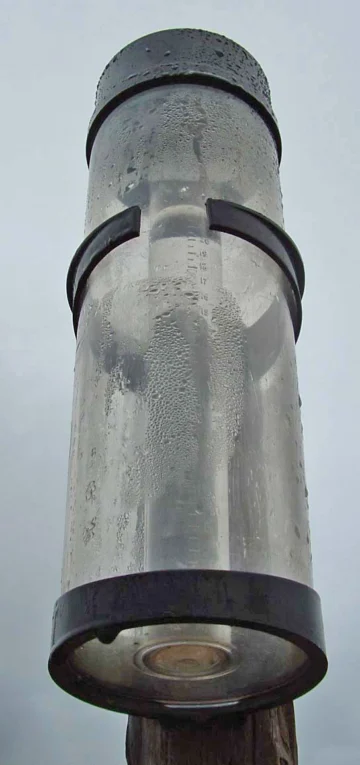

From the Namibian discussions
A Namibian mailbox item pointed growers toward weather-station information. This guide adds a complementary local practice: keep a consistent record at the place where you actually grow food. It does not claim that a household instrument replaces a professionally maintained station.
Choose measurements you can maintain
CoCoRaHS training emphasises consistent rain-gauge placement and reading. Begin with a suitable metric gauge and a notebook. A simple well-maintained record is more useful than many sensors whose position, units or calibration are unknown.
Set up the record
- Place the gauge according to its guidance, away from roof runoff, irrigation spray and obstructions that distort collection.
- Read at a consistent time and record millimetres, the date and the period covered. Empty it after recording.
- Write “not read” for a missing observation rather than entering zero. Distinguish several days collected together from a single-day total.
- Add short notes on strong wind, hail, frost, unusual heat and irrigation.
Connect weather to crops
Record sowing, emergence, flowering and harvest dates beside the weather log. Note where damage occurs: a low corner, west-facing wall or exposed edge. Rainfall is only part of the water picture; litres of irrigation and whether moisture reached the root zone help explain the result.
Compare without overclaiming
One wet month does not establish a new climate pattern. Compare several seasons and use official climate information for long-term planning. If you move a gauge or replace a sensor, note the change so an apparent shift is not mistaken for weather. Keep original readings when preparing a summary.
Namibian climate and microclimate
Thunderstorms can be highly local, and a frost pocket can be colder than the settlement around it. Coastal fog and hot inland wind also affect plants differently. Record the conditions you observe without converting every observation into a regional prediction.
Your first practical step
Start a four-column page: date, rainfall in millimetres, irrigation in litres and crop observations. Keep it for one full planting cycle.
Watch and adapt
Watch: How to read a rain gauge
Publisher: CoCoRaHS / Colorado Climate Center
Country and context: USA-based network.
Open the rain-gauge video under Step 4. Use a metric gauge and record rainfall in millimetres; the US demonstration may use inches.
The training uses a North American reporting network. Follow metric units and a suitable local observation routine; network membership is not required to keep useful records.
Keep exploring
- Plant Hardiness Zone Map
- Watering Fruit trees
- Useful farm records: begin simply, then consider farmOS
Sources and further reading
Have you tried this in Namibia? Share the site conditions, method and result—including what did not work—with the Living Earth community. Local observations help the next person adapt the idea.