
A wicking bed needs a medium that supplies roots with air as well as moisture. If plants fail in a rich mix, adding more compost, fertiliser or microbes may increase the problem. Start with drainage, moisture and the medium’s condition.
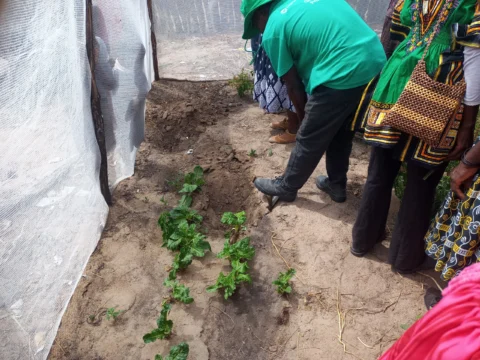

From the Namibian discussions
Namibian growers described seedling losses in beds containing generous compost, worm castings, biochar and mulch. Some beds performed well; others did not, even where the overflow worked. Participants also noticed different sun exposure. These are useful comparisons, but the discussion’s proposed fixed mixing ratios were not a controlled test.
Check the physical system first
Confirm that the reservoir overflow is open and at the intended level. Inspect moisture at several depths and compare the wettest areas with the roots. A functioning overflow does not by itself guarantee enough air in a dense growing layer. Check light and transplant condition too.
Investigate the ingredients
University extension guidance notes that compost can contain high nutrient and salt concentrations, and that testing helps match it to use. Ask whether the material is mature and suitable for container or bed production. Ordinary soil and a soilless potting medium are different systems; neither label alone guarantees performance.
Compare before rebuilding
- Keep a small sample of the original medium and record its ingredients as accurately as possible.
- Grow a few similar seedlings in a known suitable mix under comparable light and watering.
- Ask a laboratory which salinity, pH and growing-medium tests would help.
- Change a small section first, recording the result before replacing the entire bed.
Avoid blaming visible organisms alone
Earthworms, fungi and other decomposers may be present in rich organic material without being the cause of crop loss. Do not eat unidentified mushrooms or treat the bed simply because mushrooms appear. Likewise, do not deliberately dry a planted bed completely as a universal cure; root moisture requirements still matter.
Namibian climate and microclimate
High evaporation can concentrate salts, while a shaded bed may use water much more slowly than an exposed one. Two beds supplied with the same water can therefore behave differently. Record sun, water quality and plant response together.
Your first practical step
Compare root-zone moisture and a small seedling test before adding any more amendments to a failing bed.
Watch and adapt
Publisher: International Center for Biosaline Agriculture
Country and context: United Arab Emirates-based institute; exact filming location not confirmed.
A supporting sampling lesson. Ask the receiving laboratory how it wants your soil or compost samples collected.
The supporting sampling lesson helps with representative samples. Ask the laboratory for instructions specific to a growing medium rather than assuming a field-soil method is identical.
Keep exploring
- Wicking Beds
- Take a useful soil sample before buying amendments
- When seedlings collapse: recognise possible damping off
Sources and further reading
Have you tried this in Namibia? Share the site conditions, method and result—including what did not work—with the Living Earth community. Local observations help the next person adapt the idea.