
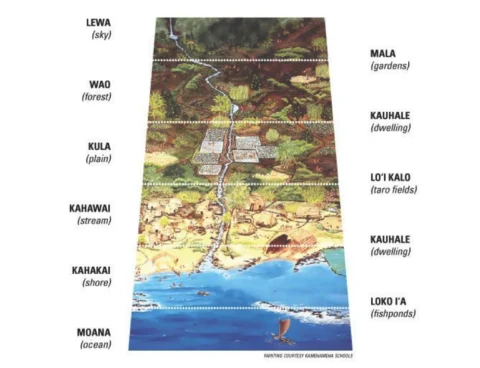
Hawaii land management is deeply rooted in traditional systems that balanced people, culture, and environment. The most well-known of these is the ancient ahupua’a system—a sophisticated form of land division and resource stewardship that helped Hawaiian communities thrive in harmony with nature.
What Is Traditional Hawaii Land Management?
Traditional Hawaii land management was based on dividing the landscape into units called ahupua’a. Each ahupua’a typically ran from the mountains (uplands) to the sea (coast) and followed natural watersheds. This structure allowed communities to access a full range of resources within a single land division—timber, fresh water, fertile soil, and marine life.
The name ahupua’a comes from ahu (altar or stone marker) and pua’a (pig), representing the offerings placed at boundaries. These divisions ensured that every community had access to diverse ecological zones and could manage resources locally and sustainably.
Sustainable Practices in Hawaii Land Management
Traditional Hawaii land management was designed for ecological balance. Each land division was overseen by a chief (ali‘i), who appointed a land manager (konohiki) to organise work, allocate resources, and enforce kapu (rules to protect nature). These included limits on fishing, harvesting, and even when certain plants or animals could be used.
Communities used advanced farming techniques such as terraced taro fields (lo‘i kalo), managed irrigation systems, and fishponds (loko i‘a) for sustainable aquaculture. Forests were protected to maintain healthy water flow, and coastal areas were managed carefully to avoid overfishing.
This watershed-based approach helped protect ecosystems, maintain clean water sources, and ensure food security—all while supporting cultural and spiritual practices tied to the land and sea.
Community and Cultural Stewardship in Hawaii Land Management
Traditional Hawaii land management was also a social and cultural system. Families worked collectively, sharing the land’s abundance while respecting its limits. The knowledge of seasons, planting cycles, and ecosystem interactions was passed down through generations.
Each person had a role in caring for the land and contributing to the wellbeing of the whole community. This system promoted reciprocity, resilience, and a deep sense of responsibility to the natural world.
Legacy and Modern Relevance of Hawaii Land Management
Although colonial land reforms disrupted this traditional system, the principles of Hawaii land management are still alive today. Many organisations in Hawai‘i are reviving the ahupuaa model in modern conservation work, watershed restoration, and community education.
These approaches are now seen as valuable tools for addressing climate change, food security, biodiversity protection, and local empowerment. The wisdom of Hawaii’s ancestral land systems continues to inspire sustainable development across the islands and beyond.
Why Hawaii Land Management Still Matters
In today’s world of environmental challenges, Hawaii land management offers a powerful lesson: when people live in harmony with their environment, everyone benefits. The traditional systems of the past can guide the solutions of the future—rooted in respect, stewardship, and sustainability.
Adapting Hawaii Land Management Principles in Namibia
Although the traditional Hawaii land management system was developed for a tropical island environment, its underlying principles can be adapted to diverse landscapes around the world, including Namibia’s arid and semi-arid regions. The core idea—designing human settlements in harmony with natural systems—can be replicated using techniques from permaculture, agroecology, and intentional community design.
Namibia, with its water-scarce ecosystems and dispersed rural populations, faces unique challenges. Yet these challenges also offer opportunities for regenerative development inspired by ancestral systems like those of Hawaii. By integrating watershed thinking, zoned land use, and community-based resource management, Namibians can build systems that are resilient, self-sufficient, and ecologically balanced.
Permaculture as a Modern Equivalent
Permaculture design offers a practical framework for applying the same principles found in traditional land systems like ahupuaa. Instead of dividing land arbitrarily, permaculture encourages careful observation of natural flows—water, wind, sun, soil fertility—and designs that work with those patterns. A well-designed permaculture homestead or village in Namibia might include greywater food circles, windbreak trees, water harvesting earthworks, and mixed crop systems supported by composting toilets and integrated livestock.
In many ways, permaculture is a contemporary expression of indigenous land wisdom, reshaped for modern needs. It’s about long-term care for the earth, care for people, and equitable sharing of surplus—values shared with traditional Hawaii land management.
Creating Intentional Communities Based on Local Ecosystems
Namibians can also take inspiration from intentional communities that echo the collective spirit of the ahupuaa. These communities are designed not just for housing, but for cooperation, shared labour, and mutual support—ideals deeply rooted in traditional societies. Instead of sprawling, disconnected settlements, intentional communities can be designed to cluster homes, gardens, water infrastructure, and social spaces around a central hub, creating vibrant, functional villages even in low-resource areas.
Such communities could be designed around zones, similar to those in permaculture and the Hawaii system, where different types of land use—from intensive home gardens to communal grazing lands—are thoughtfully arranged to match their function and frequency of use.
A Pathway Toward Regenerative Development in Namibia
By adapting the ecological thinking behind Hawaii land management to the Namibian context, a new generation of farmers, educators, planners, and community leaders can build systems that restore degraded lands, strengthen food security, reduce urban migration, and create dignified livelihoods.
This blend of indigenous wisdom, modern design tools, and local innovation could be the foundation for a national movement of regenerative development—one that not only improves living conditions but also reconnects people to land, culture, and each other.