
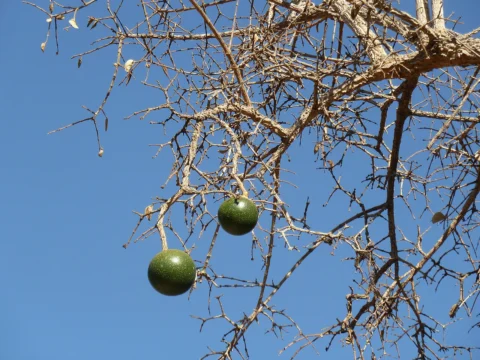
Corky-bark monkey-orange, Strychnos cocculoides, is a fruit-bearing tree of parts of tropical and southern Africa, including northern Namibia. Its hard-shelled fruit attracts interest, but “monkey-orange” is not a sufficient identification for food use.

From the Namibian discussions
The Namibian tree wish list included this species under a slightly different spelling. The corrected scientific name helps connect local knowledge with reliable botanical references. The saved list itself does not establish that a particular planting or preparation method has been tried.
Confirm the species and the edible part
SANBI describes corky bark, opposite leaves and round, hard-shelled fruit. It records use of the ripe fruit pulp. Other Strychnos species and different plant parts cannot be treated as interchangeable foods; seeds require particular caution. Do not taste an unidentified fruit or experiment with seeds and medicinal extracts. Learn identification and established fruit handling from a competent local source.
Learn from a fruiting tree
Record the location broadly, the soil and surrounding vegetation, and when ripe fruit is available. Avoid publishing precise coordinates of sensitive wild harvest sites without permission. Compare more than one season if possible: a single good fruit year can give an unrealistic expectation of regular supply.
Plan a small planting
- Obtain correctly labelled planting material and ask where the parent tree grows.
- Choose a site with room for the mature crown, protection from browsing and practical access for maintenance.
- Record establishment water, growth and cold or heat damage. A natural adult tree is not a watering guide for a recently transplanted seedling.
- Keep labels and photographs so later observations can be linked to the correct species.
Keep the food trial within established practice
Use only confidently identified ripe fruit and the locally established edible portion. Avoid turning the hard shell or seed into an improvised feed or remedy. If planning sales, first establish safe handling, identification and reliable supply with appropriate local support. For a home garden, learning to recognise and conserve useful local trees can be a worthwhile outcome even before a planted tree fruits.
Namibian climate and microclimate
A warmer northern woodland setting differs from a frost-prone highland plot. The useful question is whether your site resembles places where this species grows well, including seasonal moisture and soil—not whether it appears on a list of African fruit trees.
Your first practical step
Arrange an identification walk with someone knowledgeable about local trees. Keep a photo record of bark, leaves and fruit together.
Watch and adapt
 Watch videoWatch: Build a Nursery & Grow Trees
Publisher: Community Forests International
Country and context: Exact filming country not confirmed; Swahili with English subtitles.
A general seedling-care lesson, also catalogued by World Agroforestry. It is not a species-specific growing demonstration.
The video supports nursery organisation, but does not identify edible Strychnos species or teach fruit preparation. Keep those tasks with competent species-specific guidance.
Keep exploring
Sources and further reading
Have you tried this in Namibia? Share the site conditions, method and result—including what did not work—with the Living Earth community. Local observations help the next person adapt the idea.