
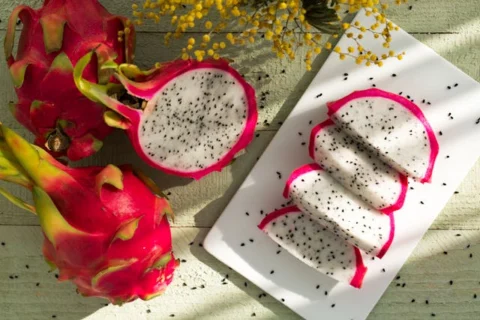
Dragon Fruit (Pitaya)
Summary
Dragon fruit (Hylocereus undatus, Hylocereus polyrhizus, and related species) is a tropical climbing cactus increasingly cultivated in Namibia for its exotic appearance, high nutritional value, and drought tolerance. Despite its cactus origin, dragon fruit thrives best in semi-arid and coastal regions where it receives partial shade, moderate humidity, and protection from frost. With careful establishment and trellising, the plant can yield fruit within 2–3 years from cuttings and produce for up to 20 years.
Cultivation in Namibia
Namibia’s harsh climate presents both challenges and advantages for dragon fruit cultivation:
- Temperature: Dragon fruit prefers temperatures between 18–32 °C. It can tolerate occasional heat spikes, but prolonged exposure above 38 °C may cause stress or sunburn on stems. Protection from frost is essential in central and southern Namibia.
- Light: While often described as a sun-loving plant, Namibian growers report better performance in partial shade—for example near a wall, tree, or under light shade cloth. This reduces sunburn and desiccation.
- Soil: The plant requires well-draining, nutrient-rich soil. A succulent mix—sand, compost, and a little clay—works best. Soils that retain too much water will cause root rot.
- Water: Although dragon fruit is a cactus, it needs regular watering, roughly once per week. Allow soil to dry between waterings. Increase watering slightly in summer during flowering and fruiting, and reduce in winter dormancy.
- Humidity: Coastal or fog-prone zones (e.g. Swakopmund, Lüderitz, Walvis Bay) provide natural humidity beneficial for aerial roots. In drier inland areas, planting near pools or shaded courtyards helps maintain micro-humidity.
Propagation and Growth
- Cuttings: The fastest propagation method is using mature stem cuttings. Plants from mature material may fruit in 2–3 years, whereas seed propagation can take 5–7 years.
- Planting: Plant cuttings vertically about 5–10 cm deep. Support with stakes until roots develop.
- Trellising: Dragon fruit vines are heavy and require strong support structures—concrete posts, wooden poles, or metal trellises. A circular top allows the stems to drape downward like an octopus, stimulating flowering.
- Pollination: Many Namibian-grown varieties are self-sterile, meaning hand pollination may be needed to ensure fruit set, especially where natural pollinators like hawkmoths are scarce.
- Flowering & Fruiting: Flowers bloom in cycles during summer (December–May), often at night. Fruit is typically harvested from January onwards, with multiple cycles possible in one season under good conditions.
Varieties and Adaptation
Namibian growers cultivate mainly:
- White-fleshed (Hylocereus undatus): Hardy, large fruit, tolerant to variable climates.
- Red-fleshed (Hylocereus costaricensis): More sensitive but sweeter and visually striking.
- Yellow (Selenicereus megalanthus): Smaller fruit with intense sweetness, adapted to coastal microclimates.
Pests and Diseases
Dragon fruit is relatively resilient but can suffer from:
- Root rot due to overwatering.
- Stem rot and fungal infections during prolonged wet periods.
- Snails and mealybugs on young shoots.
- Sunburn from intense midday heat—mitigate with shade nets or companion planting.
Biological control and organic fungicides such as neem oil or copper-free mixes are preferable within permaculture systems.
Integration into Permaculture Systems
Dragon fruit fits well into regenerative and permaculture designs:
- Climbs over trees or trellises without competing heavily for root space.
- Offers shade and microclimate benefits to lower crops.
- Flower nectar supports nocturnal pollinators.
- Its high market value can subsidise food forest maintenance.
A good pairing is planting dragon fruit on the east or north side of trees (such as moringa, leucaena, or casuarina) to provide partial protection from afternoon sun.
Economic Potential in Namibia
With growing demand from urban consumers and tourist lodges, dragon fruit offers a high-value diversification crop for smallholders. Yields can reach 20–30 t/ha under optimal care, and fruits fetch N$50–100/kg in niche markets.
Local farmers have started experimenting with value-addition—such as juices, dried fruit, and natural colourants for cosmetics.
Investment prospects include:
- Training programmes for propagation and trellising.
- Low-tech cold storage and transport systems.
- Cooperative marketing for export to South Africa.
Further Reading and Resources
- University of Namibia – Faculty of Agriculture, Ogongo Campus
- FAO: Cultivation of Pitaya in Arid Climates
- Namibia Organic Association
