
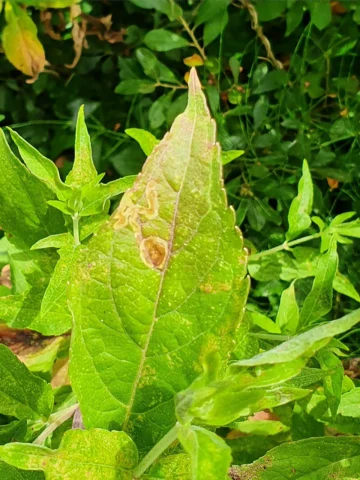
A pale winding trail inside a leaf often draws attention before the insect itself is seen. Leafminers feed within leaf tissue, but different insects make mines and not every marked leaf means the crop needs treatment.

From the Namibian discussions
A serpentine-leafminer item was saved for the Namibian wiki. No written local treatment comparison accompanied it. Use the topic as a prompt to build a local photo and crop record, rather than attaching a remedy to every white trail.
Check whether the mine is active
UC IPM describes leafminer injury and the importance of crop stage: young plants and crops sold for their leaves can be affected differently from established crops harvested for other parts. Look for fresh mines and living larvae, and compare new growth with old damaged leaves. Old scars do not disappear when the insect leaves.
Inspect a few plants consistently
- Choose several plants across the bed, including an edge and the centre.
- Record the crop, planting date and the number of inspected leaves with fresh damage.
- Photograph both sides of a leaf and any visible larva. Note other insects present.
- Repeat the check on the same schedule so you can tell whether new injury is increasing.
Protect useful insects
UC guidance warns that broad-spectrum insecticides can disrupt natural enemies of leafminers. Avoid treating a whole garden because a few old leaves look untidy. Ask for identification and a crop-specific response when fresh injury is affecting establishment or usable harvest. Product advice from California is not a Namibian registration or label.
Keep interventions measurable
If badly affected leaves are removed, avoid stripping a small plant of the healthy leaf area it still needs. Record the action and subsequent growth. Check incoming transplants and nearby host plants, but do not assume removing every flowering plant will help. A good result is healthier new growth and useful harvest, not simply fewer visible insects.
Namibian climate and microclimate
A shaded nursery, a hot open bed and a sheltered courtyard may have different pest and natural-enemy activity. Water stress can make a small amount of damage more significant. Compare plants receiving similar water before deciding which response helped.
Your first practical step
Mark five plants and photograph their newest leaves. Repeat the inspection after several days and share crop-stage information with the pictures.
Watch and adapt
 Watch videoWatch: Beneficial Insects and Natural Enemies
Publisher: University of California IPM
Country and context: USA; California context.
A supporting lesson on beneficial insects; identify the species actually present in your Namibian garden.
Learn to look for beneficial insects as well as damage. California species and treatment thresholds need local interpretation.
Keep exploring
- Critical Guide to Organic Pest Control in Southern Africa: Proven Natural Solutions for Healthier Crops
- Insect hotels and living habitat: make room for garden allies
- Seed Nursery
Sources and further reading
Have you tried this in Namibia? Share the site conditions, method and result—including what did not work—with the Living Earth community. Local observations help the next person adapt the idea.