
A small covered bed can protect young vegetables while keeping daily work manageable. The frame, edges and access matter as much as the material. Decide whether the main purpose is shade, insect exclusion or keeping larger animals out before choosing a cover.
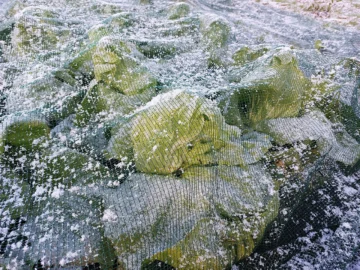
_unter_Schutznetz-6-Josef_Schlaghecken.jpg)
From the Namibian discussions
A Namibian gardener reported using a simple shade-net cover to keep rabbits off plants. That is useful firsthand experience. It does not establish that the same loose cover excludes dassies or every insect; inspect the animals and entry points at your own bed.
Match the cover to the problem
Shade cloth, fine insect mesh and stronger animal barriers have different functions. A material that reduces sunlight may still admit small insects. For larger animals, consider strength, openings and anchoring as well as the roof. Keep wildlife from becoming trapped in loose netting.
Make opening easy
- Use a manageable hinged or lift-off section rather than a cover that needs dismantling.
- Smooth sharp edges and secure loose ends.
- Leave enough height for the crop’s mature growth.
- Plan access for watering, weeding and harvesting without stepping on the bed.
Watch the changed environment
Check temperature, light and root-zone moisture after fitting the cover. A protected bed may use water differently from an open one. Some crops need pollinator access during flowering; plan suitable opening or pollination arrangements for the actual variety. A sealed cover is not automatically better.
Keep a short maintenance routine
Inspect after wind, repair holes and check that plants are not rubbing against the material. Record which damage stopped and which remained. If the cover makes harvesting so awkward that produce is missed, improve access before expanding the system.
Namibian climate and microclimate
Hot inland sites may benefit from appropriate temporary shade, while excessive shading can slow growth in cooler coastal conditions. Wind strength and the availability of spare material affect the practical design. Start with a frame small enough to repair locally.
Your first practical step
Cover one bed and compare crop damage, light and watering needs with a nearby uncovered section.
Watch and adapt
Watch: Frost and Sun Protector
Publisher: ABC Gardening Australia
Country and context: Australia; exact filming locality not confirmed.
A removable plant-protection example. It is not a guarantee against a particular frost temperature or an enclosed-greenhouse design.
The dual-purpose frame shows adaptable construction. A frost or sun cover is not necessarily an animal-proof enclosure.
Keep exploring
- Shadehouse
- Red insect netting: separate a promising study from a local result
- Dassies and food gardens: protect a patch and observe
Sources and further reading
Have you tried this in Namibia? Share the site conditions, method and result—including what did not work—with the Living Earth community. Local observations help the next person adapt the idea.