
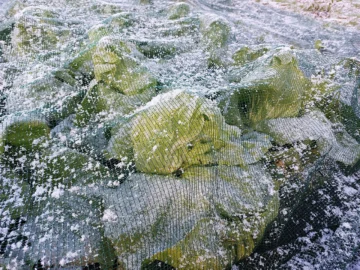
Red netting has attracted attention as a way to reduce insect entry. The promising question is specific: can a particular net keep a particular pest away while preserving enough light and ventilation for the crop?
_unter_Schutznetz-6-Josef_Schlaghecken.jpg)
From the Namibian discussions
The Namibian collection saved a “red crop nets deter pests” lead without a local trial report. It is worth testing, but the colour claim should not become a guarantee that any red shade cloth controls every pest.
What the research actually tested
A University of Tokyo report describes Japanese experiments with differently coloured nets, onion thrips and Kujo leeks. The results support further work on colour as well as mesh size. They do not establish equal performance for Namibian insects, different crops or an ordinary red fabric.
Specify the material
Ask for mesh aperture, light transmission, airflow characteristics and UV durability. Shade percentage and insect exclusion are different properties. Check how the material will be supported and sealed at doors, edges and irrigation openings. An excellent net with open edges may exclude very little.
Compare two small beds
- Use the same crop and similar soil, watering and planting date.
- Compare the proposed net with your current protection while keeping the trial small enough to manage.
- Record temperature, pest counts and crop growth inside each treatment.
- Record beneficial insects and any pollination problem as well as pest damage.
Keep ventilation in the decision
Inspect after wind and heat, repair gaps and avoid leaves being rubbed by loose fabric. If the covered crop overheats, improved pest exclusion may not compensate for the loss. Remove or alter protection when the crop’s pollination needs require it, using advice for the actual crop and pest.
Namibian climate and microclimate
Namibian heat, dust and strong sun make ventilation and durability central. Japanese growing conditions and pest pressure are different. A net trial should include a hot spell and ordinary wind exposure before expansion.
Your first practical step
Ask a supplier for the actual mesh and light specifications, then plan one small comparison with recorded temperatures and pest observations.
Watch and adapt
 Watch videoWatch: Beneficial Insects and Natural Enemies
Publisher: University of California IPM
Country and context: USA; California context.
A supporting lesson on beneficial insects; identify the species actually present in your Namibian garden.
The supporting insect lesson helps identify what is being excluded. It is not a demonstration of red-net performance.
Keep exploring
- Shadehouse
- Critical Guide to Organic Pest Control in Southern Africa: Proven Natural Solutions for Healthier Crops
Sources and further reading
Have you tried this in Namibia? Share the site conditions, method and result—including what did not work—with the Living Earth community. Local observations help the next person adapt the idea.