
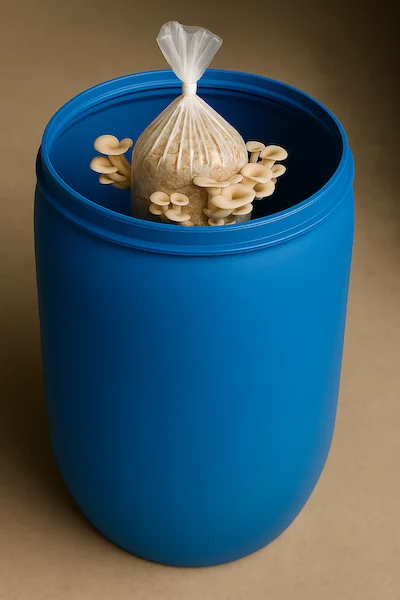
Growing mushrooms in a mushroom drum using bags is a simple and effective method that anyone can try at home. Here’s a step-by-step guide:
What You Need to build your Mushroom drum
• A big plastic or metal drum
• Mushroom spawn (tiny mushroom seeds)
• Growing media (like straw, sawdust, or coffee grounds)
• Strong plastic bags (to hold the growing media)
• Water
• A drill (to make holes in the drum)
Steps to Grow Mushrooms in a Drum
1. Prepare the Drum: Clean the drum well. Drill some holes around the sides of the drum. These holes will let fresh air in and help keep the mushrooms healthy.
2. Prepare the Growing Bags:
• Fill strong plastic bags with the growing media, like straw or sawdust. Make sure the media is moist but not soaking wet.
• Mix in the mushroom spawn (tiny seeds) with the growing media in each bag.
3. Hang the Bags Inside the Drum:
• Hang the bags inside the drum. The drum helps keep the environment just right for the mushrooms to grow—dark, cool, and humid.
• Make sure there is some space between the bags for air to flow.
4. Incubation:
• Close the drum and keep it in a dark, warm place (around 20-25°C). This will allow the mushroom seeds to spread and grow inside the bags.
5. Fruiting Stage:
• After a few weeks, you will see small mushrooms starting to form inside the bags. This means it’s time to move the drum to a spot with some light but not direct sunlight.
• Keep the drum slightly open or make more holes to increase airflow. Spray water inside to keep the bags moist.
6. Harvesting:
• Once the mushrooms are big enough, cut them off gently. Be careful not to damage the bags or the remaining mushrooms.
Tips for Success
• Ideal Temperature: Keep the drum at around 20-25°C for growing and 15-20°C for fruiting.
• Maintain Moisture: Spray water regularly inside the drum to keep it humid.
• Control Temperature: If it’s too hot, spray cool water on the drum or place it in the shade. If it’s too cold, insulate it with blankets or cloth.
By hanging the mushroom bags inside a drum, you can create a perfect little environment for growing delicious mushrooms at home!
Scaling Up and Diversifying Mushroom Cultivation
The mushroom drum is just one part of a growing toolkit of low-cost, low-tech cultivation methods suited for African conditions. As more people explore mushrooms for income, nutrition, and enterprise, it’s useful to compare techniques and understand the broader context in which they operate.
This fruiting crop is a rare kind of miracle—it converts waste into food, needs no sunlight, grows vertically, and offers protein with minimal land and water. But there are many ways to grow mushrooms, and each has pros, cons, and different water needs.
Why Mushrooms Matter
In a changing world, where land is degraded and rainfall erratic, mushrooms offer a highly efficient way to produce food and income:
- Fast growth: Most species mature in 2–4 weeks.
- High yield per square metre: You can stack bags or buckets vertically.
- Excellent food value: High in protein, B-vitamins, selenium, fibre.
- Grows on waste: Sawdust, corncobs, cardboard, paper, manure, banana leaves.
- Low water use: Especially important in dry climates like Namibia.
- Income potential: Sold fresh, dried, or processed; fetches high prices in urban centres.
In regions where land for farming is limited or degraded, mushroom growing especially in a mushroom drum can happen in backyards, under trees, in old shipping containers, or even in abandoned toilets or brick rooms.
Overview of Common Mushroom Growing Methods
There are several low-tech ways to grow mushrooms without needing large commercial equipment. The mushroom drum is just one of the methods. Here we compare the most common:
Mushroom Drum
- Structure: A sealed plastic drum (usually blue), with a hanging bag of substrate inside.
- Ideal for: Beginners, schools, dry climates, homestead settings.
- Substrate: Sawdust, paper, corncobs, or a mix.
- Water Use: Very low. Retains humidity within the drum—uses misting sparingly.
- Advantages: Low maintenance, protected from wind and dust, affordable.
- Challenges: Needs careful hygiene; only one bag per drum.
This mushroom drum method is the favourite for us as it’s easy and doesn’t need much water.
Vertical Hanging Bags
- Structure: Plastic bags filled with pasteurised substrate, hanging on strings.
- Ideal for: Shaded areas, sheds, greenhouses.
- Substrate: Sawdust, straw, corncobs.
- Water Use: Medium. Requires regular misting or a fogging system.
- Advantages: Simple, scalable, space-saving.
- Challenges: Susceptible to drying out in dry climates or windy conditions.
Bucket Method
- Structure: 10–20 litre plastic buckets with holes drilled in the sides.
- Ideal for: Backyard growers, urban gardens.
- Substrate: Straw or sawdust mix.
- Water Use: Low to medium. Water can be retained inside bucket walls; some misting needed.
- Advantages: Reusable containers, neat stacking.
- Challenges: Heavier than bags; less air exchange.
Log Inoculation
- Structure: Logs inoculated with spawn, placed in shade or under trees.
- Ideal for: Forest gardens, permaculture farms.
- Substrate: Hardwood logs (for species like shiitake).
- Water Use: Low. Occasional soaking in dry periods.
- Advantages: Long-term production (up to 3 years), minimal effort after setup.
- Challenges: Takes months to fruit; requires shady outdoor space.
Grow Tents or Shelters
- Structure: Polytunnels, tents, or small rooms lined with bags or buckets.
- Ideal for: Group projects, cooperatives, school-based enterprises.
- Water Use: High unless closed-loop misting systems are used.
- Advantages: Higher yields, protection from pests and contamination.
- Challenges: Expensive to build and maintain, needs good airflow and water management.
Water Efficiency of Each Method (Quick Comparison)
| Method | Water Use | Best For | Risk in Dry Climates |
|---|---|---|---|
| Mushroom Drum | Very Low | Homesteads, dryland areas | Minimal—self-contained drum |
| Hanging Bags | Medium | Backyard & urban growers | Can dry out without humidity |
| Buckets | Low-Med | Small farms, urban rooftops | Moderate misting needed |
| Log Cultivation | Low | Rural shaded farms, agroforests | Needs shade; seasonal yields |
| Grow Tents/Shelters | High | Intensive commercial production | High evaporation risk |
Mushrooms in Schools and Youth Projects
One of the best places to start with mushroom cultivation in a mushroom drum is at schools. A mushroom drum is easy enough for Grade 8–10 learners to build and manage, and it introduces valuable life skills:
- Science & Biology: Learners explore decomposition, fungi life cycles, and ecosystems.
- Entrepreneurship: They sell mushrooms to neighbours or school kitchens.
- Sustainability: They learn about waste reuse and closed-loop systems.
A typical school drum project uses:
- Sawdust from nearby carpenters,
- Pasteurised with boiled water or lime,
- Spawn inoculated and hung inside the drum,
- Misted daily for 15–20 days.
Yields can range from 1–2 kg per cycle, and each drum can cycle 3–4 times before the substrate is spent.
Making Your Own Spawn Locally
While spawn (the fungal starter culture) is often imported, local labs or farmer cooperatives can begin producing their own. This not only reduces cost—it builds local resilience and innovation.
Basic spawn production involves:
- Pressure cooking sterilised grain (like sorghum or millet).
- Inoculating it with a clean culture from a lab or agar plate.
- Allowing it to colonise fully.
- Storing in clean bottles or bags.
Some mushroom cooperatives in Uganda, Kenya, and Malawi have begun producing village-level spawn using simple pressure cookers and sterilisation jars. So if you are used to growing mushrooms in your mushroom drum why not also sell spawn?
Pairing Mushrooms with Other Systems
Mushrooms fit beautifully into integrated farming systems:
- After compost: You can grow mushrooms on partially broken-down straw or paper waste before composting the spent substrate.
- In food forests: Logs or shaded corners can become mushroom beds.
- With aquaponics: Some growers use fish waste water for misting chambers.
Spent mushroom substrate (SMS) from your mushroom drum is a valuable soil builder. It adds organic matter and supports beneficial microbes. It can also be fed to worms, chickens, or used directly in vegetable beds.
Business Opportunities and Markets
Fresh mushrooms can fetch N$60–120 per kg in Windhoek or Swakopmund, with even higher prices in smaller towns due to limited availability.
Small-scale business models include:
- Fresh market sales: to shops, restaurants, and private homes.
- Dried mushrooms: with longer shelf life and higher transport value.
- Mushroom powders: for smoothies or health supplements.
- Teas and extracts: using medicinal mushrooms like reishi or turkey tail.
For best results, cooperatives or social enterprises should focus on quality control, hygiene, consistent delivery, and good packaging.
Where to Learn More
Recommended Books
- Growing Gourmet and Medicinal Mushrooms by Paul Stamets – the global classic, especially for spawn production and species selection.
- Mushroom Cultivation in Africa by Dr. G.C. Nwoko – covers low-cost techniques adapted for African conditions.
- The Forest Garden Greenhouse by Jerome Osentowski – includes integration of mushrooms in food forests.
Online Resources
- www.growyourfood.africa/wiki/mushroom-drum/
- ECHOcommunity.org – Mushrooms in tropical agriculture
- FAO Mushroom Cultivation Manual
Worthwhile Videos
 Watch video“Oyster Mushroom Farming in Kenya” – Shamba Shape Up
 Watch video“Mushrooms from Waste” – African Agribusiness TV
 Watch video“Bucket Mushroom Growing Tutorial” – Homestead Africa
Final Thoughts
Mushrooms are a revolution in quiet form. They don’t need tractors, pesticides, or vast land. They grow in corners, in barrels, in forgotten spaces—turning waste into wealth and humidity into nutrition.
For Namibia and the wider region, mushroom cultivation represents a powerful strategy: low water, low input, high return. The mushroom drum, in particular, is a uniquely practical entry point for learners, farmers, and backyard growers alike.
As demand grows, so does the opportunity to create local mushroom economies: from rural youth enterprises to urban growing clubs, from school food projects to national processing hubs.
In a dry land, this humble fungus may just be one of the most important crops of the future.