
Wild medlar, Vangueria infausta, is an indigenous African shrub or small tree with edible ripe fruit. It can be part of a diverse food landscape where the site suits it. Its value is easier to assess from local specimens than from a promise of rapid orchard production.

From the Namibian discussions
Namibian growers listed wild medlar among trees they wanted to plant. The saved discussion did not provide a local germination method or yield record. Existing household knowledge of fruiting places and seasons is a useful starting point for a documented trial.
Find and identify a reference plant
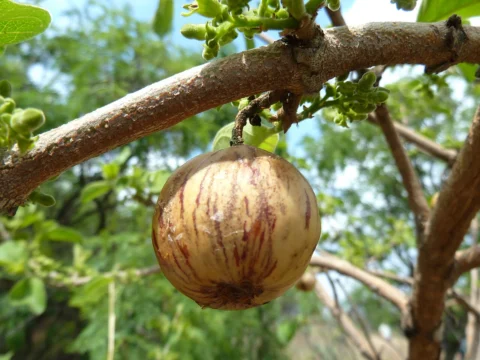
World Agroforestry describes a deciduous, light-demanding plant associated with woodland and wooded grassland, including rocky or sandy settings. The ripe fruit turns brown. Ask a knowledgeable local person to confirm the species and ripe-fruit use; a common name alone is not enough to identify something for eating.
Allow time for establishment
The tree profiles describe slow growth and potentially slow seed germination. Plan accordingly: label seed trays clearly and do not discard them on an arbitrary quick-crop timetable. A purchased healthy seedling may be a more practical first step for someone without nursery space. Ask how long the plant has been in its container.
Make the trial easy to maintain
- Choose an open position with room for the mature plant and access for fruit collection.
- Protect it from browsing and record initial height, condition and planting date.
- Monitor root-zone moisture during establishment, adjusting to soil, rain and heat rather than stopping water after a fixed number of weeks.
- Record leaf emergence, flowering, fruit and wildlife visits. Note unsuccessful seasons as well as good harvests.
Keep a useful harvest record
Record ripe fruit collected in kilograms, time spent collecting and any losses. This can show whether a tree contributes a snack, household food or a possible surplus. Do not promise a market until supply and handling are understood. Compare taste and fruit characteristics between confidently identified trees without stripping all fruit needed by wildlife or regeneration.
Namibian climate and microclimate
The supporting tree profiles cover southern and eastern African conditions, including Tanzania. Their habitat descriptions are useful, but local cold, rainfall timing and drying wind still determine performance. Protect a young plant while it develops roots; indigenous does not mean maintenance-free.
Your first practical step
Locate a fruiting wild medlar and begin a seasonal record. If you plant one, keep the source label and record both water input and growth.
Watch and adapt
 Watch videoWatch: Build a Nursery & Grow Trees
Publisher: Community Forests International
Country and context: Exact filming country not confirmed; Swahili with English subtitles.
A general seedling-care lesson, also catalogued by World Agroforestry. It is not a species-specific growing demonstration.
The nursery demonstration is a general workflow. Wild medlar may germinate and grow slowly, so do not borrow the film’s timing for this species.
Keep exploring
Sources and further reading
Have you tried this in Namibia? Share the site conditions, method and result—including what did not work—with the Living Earth community. Local observations help the next person adapt the idea.