

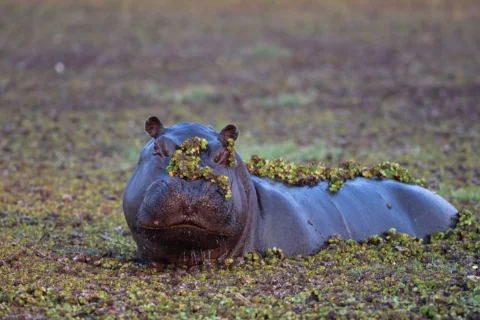
Kariba Weed (Salvinia molesta) is a very fast-growing floating fern. In Namibia it is an alien invasive that causes problems in natural wetlands, especially in the Zambezi Region. But in our dry villages, it cannot survive outside water for long. With tight containment (tanks, filters, no leaks) and no chemicals, small communities can trial it as a supplementary feed—mainly for ducks and tilapia—while protecting rivers and neighbours.
Why the caution first?
- It is not a local plant; it comes from south-eastern Brazil. In natural waters it forms thick mats that block light and oxygen and harm fisheries and transport. Namibia and neighbours spent years fighting it. Please keep it out of nature.
- Namibia has run a biocontrol programme with the salvinia weevil (Cyrtobagous salviniae) since the 1980s in the Eastern Caprivi (Zambezi). This reduced mats strongly, but reinfestation can happen with floods. Your village system must not leak fragments.
Where it occurs (and why you must contain it)
Kariba weed has long been recorded in Namibia’s north-eastern rivers and backwaters, including historical records from the Zambezi system. It thrives in warm, nutrient-rich, slow-moving water—for example near runoff from fields. That is exactly why it grows so fast in containers too.
Identification (so you don’t mix it up)
Kariba weed is a free-floating fern with two velvety upper fronds and a third “root-like” frond hanging below each node. Mats can become thick and spongy. If unsure, avoid using it and rather choose duckweed or Azolla.
If you still want to try growing Kariba weed: the safe village system (no chemicals)
Principle: double containment + daily discipline.
- Containers only Use IBC totes, tanks, or troughs inside a secondary bund (low brick tray or plastic kiddie-pool) to catch spills. Put them on hard ground, well above flood lines, and at least 30 m from drains or streams. Fit all outlets with stacked filters (insect mesh, then fine screen, then geotextile). Keep a net or shade-cloth lid on each tank to stop wind-blown fragments and birds.
- Dedicated tools Use separate buckets/nets. After work, sun-dry tools so any pieces die. Have a dry boot-brush at the gate to the grow area.
- Water and nutrients It grows fastest with warmth and nutrients. Use aged manure tea or strained greywater from animal areas—avoid salty water. Expect rapid growth in warm months.
- Harvesting Skim often (daily or every second day). De-water on racks over the bund so drips fall back into the system. Never move live plants outside the bund.
- Kill Kariba weed before any use (biosecurity step) Choose one:
- Solarise in clear bags on corrugated iron until completely crisp and brown; or
- Hot-compost (keep ≥55 °C for several days, then turn); or
- Convert to biochar in a simple drum kiln (best biosecurity). Only once it is dead and dry may you mill or mix it.
Feed use of Kariba weed: realistic, low-risk inclusion rates
Kariba weed is not a full feed. Protein and minerals are modest; fibre and tannins are high. Start small, measure results, and adjust.
- Ducks: Practical results suggest about 10–12.5% of the ration (dry basis) can work without harming performance and can even reduce costs. Do not jump higher without trials.
- Broilers / village chickens: Treat as a minor ingredient. Studies show rations with low single-digit percentages are safer; higher levels can depress intake and growth. Start at 2–4%, monitor feed conversion and weight gain.
- Quail: A controlled trial in quail tested 2%, 4%, 6% inclusion; keep to the lowest levels unless you have careful records and good results.
- Tilapia: Works best as a supplement together with normal pellets. A 23-day study found growth slightly higher when fish had both Kariba weed and feed compared to feed alone. Let fish nibble fresh plants kept inside their tank or a side-trough.
Tip: If you have other greens (vegetable leaves, lucerne), ensile or chop-mix with Kariba weed to improve palatability and balance.
Should we rather grow duckweed or Azolla?
For small desert villages with little water, these are often better feed plants in tanks:
- Duckweed (Lemna spp.): frequently 20–40%+ protein (DM) under good management; strong record in poultry and fish systems.
- Azolla: typically ~19–30% protein (DM); many trials in fish, poultry and small ruminants; lots of open guidance.
If your local rules make Kariba weed possession difficult, simply use the same container setup for duckweed or Azolla.
Legal and community responsibility in Namibia
- Namibia treats Kariba weed as a serious invasive; the country led early biocontrol efforts in the Eastern Caprivi in the 1980s. Keep any experiment strictly contained and away from natural waters.
- For the latest guidance, check the Namibian Invasive Alien Species Working Group notes and the 2024 legal review on invasive species (under the Environmental Management Act discussions). Rules are evolving; confirm what is allowed before starting.
- To identify or report wild salvinia, use Atlasing in Namibia (EIS).
Summary of Kariba weed for village use (dryland context)
- Yes, Kariba weed grows fast, even in small tanks, which is helpful when money and water are limited.
- But treat it like a biohazard: containers only, double bunds, filters, covered tanks, dedicated tools, and always kill before use.
- Keep inclusion rates low and watch animal performance.
- If in doubt—or if permits are unclear—choose duckweed or Azolla instead. They are simpler, safer, and often higher in protein per litre of water.
Responsible utilisation & small-scale feed ideas (for dry villages)
Why “pellet businesses” aren’t promoted for Kariba weed in Namibia. National policy focuses on prevention and biocontrol, because this plant spreads from tiny fragments. Moving fresh, wet biomass to a factory risks new invasions, and the law is tightening around invasive species management. See the Atlasing in Namibia species note and the 2024 legal review prepared for the Namibian Invasive Alien Species Working Group.
Biosecurity and supply realities. Big salvinia biomass is mostly in the far north-east; elsewhere Namibia is too dry. Where the salvinia weevil is established, mats collapse and supply becomes unreliable—bad for a centralised plant. Historical records from Eastern Caprivi show why the state prioritises weevils and vigilance over utilisation schemes.
Feed quality limits. As a feed ingredient, salvinia’s protein is modest and fibre/tannins are high, so it works only at low inclusion rates (for poultry) or as a partial supplement (for tilapia). See the Feedipedia profile and controlled trials on broilers, quail and tilapia.
What does work nearby (copy the idea, not the weed)
Across Lake Victoria, entrepreneurs turn the invasive water hyacinth into products that avoid feed-safety and transport risks: biodegradable packaging (HyaPak) and fuel briquettes run by community groups. These show a practical “harvest the problem” model without spreading the weed.
If you still want to try salvinia for on-site village feed (no chemicals)
Keep it micro-scale and on the same site as use—no trucks, no live material leaving.
- Permissions & intent. Ask MAWLR/NIASWG for written guidance; frame it as assisted removal with on-site neutralisation and use, not farming a listed invader.
- Containment. Harvest with booms; all de-watering happens inside a bunded area. Kill at the water’s edge by solarising until crisp, hot-composting (≥55 °C), or making biochar—only dead, dry material is milled.
- Pellet/blend. Dry-mill and blend low: poultry at a few per-cent (broilers/quail), ducks up to roughly 10–12.5% if performance holds; tilapia can nibble fresh in side-troughs with a normal pellet. Keep records of weight gain and FCR.
- Plan B. If weevils crash the local mats (a win for the river), switch your tanks to safer, high-protein aquatics like duckweed or Azolla using the same container system.
Safer, higher-protein tank crops for dry villages
For little water and little money, duckweed and Azolla usually beat salvinia as tank-grown feed: they offer higher protein and a stronger evidence base for smallholders. See the Feedipedia pages and summary resources.
Namibia context & reporting
Kariba weed remains the most problematic aquatic invader in Namibia’s perennial rivers. If you see it in the wild, report it via Atlasing in Namibia (photos + location). Policy updates and guidance are available through the Namibian Invasive Alien Species Working Group and the national review of invasive species.
Key sources linked above: Atlasing in Namibia (species ID and impacts), EIS eLibrary (Eastern Caprivi biocontrol history), Feedipedia (nutritional profiles), peer-reviewed/technical studies on inclusion rates, and regional enterprise examples (HyaPak, Lake Victoria hyacinth briquettes).
Useful references (open sources)
- Atlasing in Namibia: species page “Kariba weed / Salvinia molesta.” Habitat, impacts, reporting.
- Conservation Namibia: history of salvinia in Namibia and early biocontrol timeline.
- EIS eLibrary: “Biological control of Salvinia molesta in Eastern Caprivi” (historic programme document).
- Feedipedia: Salvinia composition and feeding notes.
- Studies on inclusion rates: broilers, quail, ducks; tilapia supplement trials.