
Sea buckthorn, Hippophae rhamnoides, is a thorny fruiting shrub discussed in the group material as a possible crop. Treat it as a site-and-cultivar question rather than assuming that hardiness means low-water fruit production.
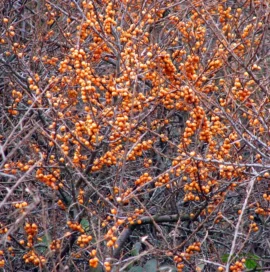
Photo: Evelyn Simak · Original image · CC BY-SA 2.0. Wikimedia display-size version; no crop or content edits.
_-_berries_-_geograph.org.uk_-_1119280.jpg)
From the Namibian discussions
The saved material includes a South African nursery link and a video recommendation. It does not contain a Namibian harvest or irrigation record. A supplier’s ability to sell a plant in southern Africa is a lead to investigate, not a record of performance at your site.
Ask about the actual planting material
Ontario’s crop guidance describes sea buckthorn as a perennial crop and discusses propagation and production requirements. Confirm the cultivar, sex of plants and a compatible pollination arrangement with the supplier. Ask specifically for fruiting records from a climate resembling yours, not only survival photographs.
Make the water question explicit
Manitoba’s production guidance places best growth in areas receiving roughly 400–600 mm of precipitation and says the crop does not favour dry conditions. That figure is not a Namibian irrigation prescription: rainfall timing, evaporation and soil differ. Cold tolerance should not be confused with a guarantee of productivity during hot, dry weather.
Plan a contained trial
- Choose a small planting with reliable care and an identified pollination plan.
- Record soil condition, winter temperatures and summer heat exposure.
- Measure supplementary water and note flowering and fruit set.
- Record suckering, thorns, access and harvesting effort.
- Delay larger planting until you have useful local results.
Consider the harvest and use
Fruit can be difficult and labour-intensive to harvest, as the Manitoba guidance notes. Find out how your household or buyer would use it and what equipment is required. Avoid building an income estimate around overseas yields or medicinal marketing claims.
Namibian conditions and microclimate
Cold inland nights, a sheltered urban garden and a mild coastal site are different tests. Soil drainage, irrigation salinity and wind exposure also need attention. Ask for local experience that includes fruiting, not merely the plant remaining alive.
Try it locally and share what happens
Before purchasing, ask the supplier for the exact cultivar and pollination requirements, plus the nearest documented fruiting example. Record unanswered questions as part of your decision.
Watch, understand, adapt
On-farm soil sampling
Country and context: United Arab Emirates — ICBA is based in Dubai; filming location not confirmed.
A supporting skill for investigating soil before committing to an unfamiliar crop.
Apply it locally: Ask your local laboratory which depth and tests it needs. A dry-climate demonstration does not imply identical soil salinity or fertility.
Keep exploring
Water-efficient plant selection · Fruit trees · Plant hardiness