
Black soldier fly production is easier to evaluate when incoming material and harvested larvae are measured. A successful demonstration is not enough to establish feed safety or a viable business. Start with traceable material, competent guidance and a small unit whose daily work you can manage.
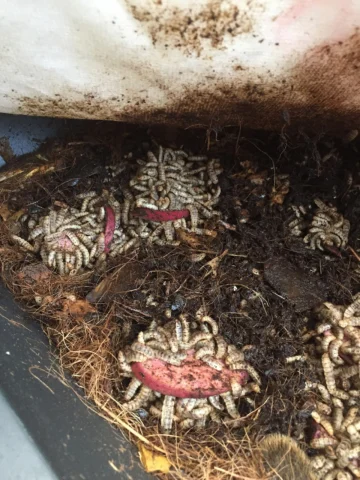

From the Namibian discussions
The Namibian collection included BioBuu training manuals for a 2021–2022 community programme in Dar es Salaam and Morogoro, Tanzania. The English manual describes weighing incoming material and larvae, assigning responsibilities and reviewing household experience. Those management habits are useful to adapt locally.
Define acceptable inputs
Agree a feedstock list with an adviser familiar with insect production and the intended animal feed use. Separate unsuitable or contaminated material before it reaches the unit. “The larvae will eat it” is not proof that the resulting larvae are suitable feed. Keep each source traceable and check applicable requirements before selling.
Weigh consistently
- Weigh the empty container or zero the scale with it in place.
- Record kilograms of each feedstock and any added water.
- Record the date, batch and conditions in the rearing area.
- Weigh the harvested larvae separately from residue and record their destination.
Understand what the numbers mean
Fresh larvae and fresh feedstock contain varying amounts of water. A simple fresh-mass ratio is useful for managing one process, but it is not a laboratory nutrient analysis or a dry-matter conversion result. Record labour, rejected inputs, losses and cleaning as well as harvest.
Plan the next stages
Get suitable advice on harvesting, processing, storage and balanced livestock rations. The residue also needs appropriate management; it is not automatically a sanitised fertiliser. Start with a manageable pilot and make sure someone is responsible every day, including weekends and holidays.
Namibian climate and microclimate
The Tanzanian programme operated in a warmer, more humid context than many Namibian sites. Cold nights, dry air and overheating containers can all affect production. Measure the rearing environment and include any water, shade or heating cost in the trial.
Your first practical step
Create a batch sheet with input mass, water additions, harvest mass, conditions and daily labour before increasing production.
Watch and adapt
Watch: Black soldier fly processing: instructional video collection
Publisher: Eawag / Sandec
Country and context: Swiss research institute; training includes Indonesian project experience.
Open the instructional playlist on the resource page. Consider feedstock control and the full production workflow, not only a rapid feeding demonstration.
The international training material includes tropical processing examples. Adapt the environment and feedstock controls before assuming the same production rate in Namibia.
Keep exploring
- Black Soldier Fly Larvae (Maggots)
- Fish feed
- Termites as poultry feed: local observation and a cautious trial
Sources and further reading
Have you tried this in Namibia? Share the site conditions, method and result—including what did not work—with the Living Earth community. Local observations help the next person adapt the idea.