
“Sea spinach” is a common name, not a reliable botanical identification. Coastal plants can offer food and habitat value, but a plant growing near salt water is not automatically edible or suitable for collection.
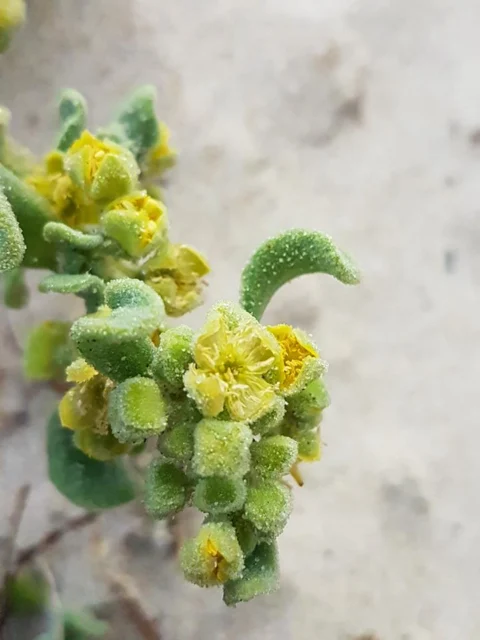

From the Namibian discussions
Local contributors recalled enjoying a bottled or pickled coastal plant and mentioned places around Walvis Bay and Swakopmund. The saved text does not establish which species they meant. Those reports are useful leads for an identification conversation, not a licence to collect from a lagoon or industrial water channel.
Separate a known species from an uncertain name
SANBI describes Tetragonia decumbens, dune spinach, as an edible coastal dune plant occurring from southern Namibia to the Eastern Cape. It also helps stabilise sand. That description does not identify the plant in the saved discussion; other coastal plants may be called sea spinach.
Document before tasting
- Photograph the whole plant, leaves, flowers and fruit without damaging the habitat.
- Ask a qualified botanist or experienced local specialist to confirm the scientific name.
- Record the broad habitat and the authority or landholder responsible for access.
- Confirm the established edible part and preparation method for that exact species before considering food use.
Consider the collection site
Edibility of a species says nothing about pollution at a particular site. Wastewater, industrial channels, runoff and protected habitats require separate consideration. Washing cannot be relied upon to remove every contaminant. Do not publish a sensitive collecting location or remove dune vegetation simply because it appears plentiful.
Prefer a supervised cultivation trial
Once identified, ask a reputable nursery or conservation authority about permitted propagation material. Test a few plants in conditions appropriate to the species and label them. Measure supplementary water and observe how they perform away from coastal moisture. Share a confirmed name and cultivation notes rather than an ambiguous food recommendation.
Namibian climate and microclimate
Coastal fog, cool air, salt exposure and sandy drainage differ sharply from hot inland gardens. A coastal plant’s survival does not prove salt tolerance of vegetables generally, nor that sea water is suitable irrigation.
Your first practical step
Turn the saved “sea spinach” lead into a verified plant record with a scientific name and a safe, permitted source. Do not taste an unidentified specimen.
Watch and adapt
 Watch videoWatch: Build a Nursery & Grow Trees
Publisher: Community Forests International
Country and context: Exact filming country not confirmed; Swahili with English subtitles.
A general seedling-care lesson, also catalogued by World Agroforestry. It is not a species-specific growing demonstration.
The seedling-care lesson supports a later cultivation trial; it cannot identify an edible coastal species.
Keep exploring
Sources and further reading
Have you tried this in Namibia? Share the site conditions, method and result—including what did not work—with the Living Earth community. Local observations help the next person adapt the idea.