
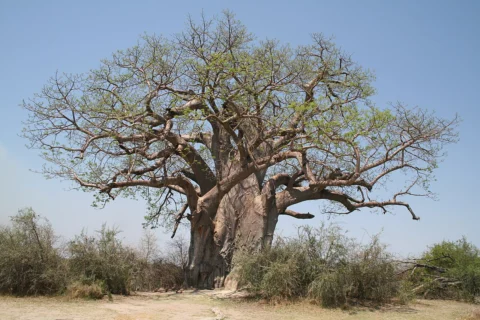
An African baobab, Adansonia digitata, can become a remarkable long-lived tree. It is a landscape commitment with eventual food and habitat value, not a quick solution for a small vegetable garden. Start with climate, space and responsibility for the tree’s future.

From the Namibian discussions
Baobab appeared in the Namibian indigenous-tree wish list. The saved request did not claim a successful local nursery or fruit-production trial. Existing trees in warmer parts of Namibia offer a better reference than photographs of other baobab species from elsewhere.
Identify the species and the site
SANBI describes Adansonia digitata as suited to warm, frost-free conditions with well-drained soil. Young plants need protection from cold. Madagascar’s distinctive baobab species are not interchangeable with this African species, so check the scientific name on seed packets and nursery labels.
Leave enough room
Sketch the mature-tree position in relation to buildings, pipes, roads, boundaries and future land use. Do not assume regular pruning can make an enormous tree suitable for a confined courtyard. A shared-space planting needs agreement about maintenance, access and the long-term use of the land. If space is limited, contributing to protection of an existing tree may make more sense.
Treat a nursery trial as a trial
- Obtain correctly identified material and ask for a reliable propagation method for this species.
- Use freely draining conditions and observe moisture carefully; neither permanent saturation nor neglect is a useful experiment.
- Label the source and record seasonal leaf behaviour, growth and any cold damage.
- Before moving a plant into the ground, confirm that the proposed site has the space and winter conditions it needs.
Learn food use separately from tree growing
Baobab fruit has established food uses, but planting a seedling does not provide an immediate or predictable crop. Learn identification and handling of mature fruit from experienced local users and reliable food guidance. For any proposed sale, assess collection rights, supply, cleaning, storage and processing requirements before projecting revenue. Keep trees and community access in the plan.
Namibian climate and microclimate
A warm northern setting and a frost-prone inland garden can be very different environments. A protected young plant surviving one winter does not show that the eventual outdoor tree will be suitable. Drainage and winter cold deserve as much attention as summer heat.
Your first practical step
Visit a local baobab or nursery specialising in indigenous trees, compare the site conditions and decide whether you have a genuinely suitable long-term position.
Watch and adapt
 Watch videoWatch: Build a Nursery & Grow Trees
Publisher: Community Forests International
Country and context: Exact filming country not confirmed; Swahili with English subtitles.
A general seedling-care lesson, also catalogued by World Agroforestry. It is not a species-specific growing demonstration.
The nursery lesson is useful for organising seedlings. It does not establish baobab frost tolerance, mature spacing or a timetable to fruit production.
Keep exploring
- Shared garden land: agree access and responsibilities before planting
- Fruit trees
- Garden weather records: learn what happens at your own site
Sources and further reading
Have you tried this in Namibia? Share the site conditions, method and result—including what did not work—with the Living Earth community. Local observations help the next person adapt the idea.