
This flowering shrub or small tree appears in the original agroforestry list. Use its botanical name, check the local form and trial it before making promises about biomass or soil fertility.
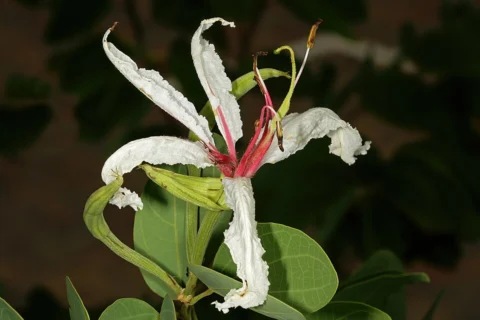

Use the botanical name
Ask for Bauhinia petersiana. The old overview called it “Elephant Root Tree”; common names can be ambiguous. It is not the same plant as marama bean, Tylosema esculentum. Do not transfer food uses from one plant to the other.
- Confirm the botanical identity with a knowledgeable nursery or botanist.
- Ask about the plant’s origin and mature form at a nearby site.
- Choose a place with room for its natural growth.
- Start with a small labelled nursery batch or one correctly identified plant.
- Record watering, growth, flowering and any pruning response.
Form and origin matter
World Agroforestry’s Tanzania factsheet describes a shrub or small tree with two-lobed leaves, white flowers and pods. Growth form varies; a photographed flower does not tell you the final size of the plant offered by a nursery. Read the illustrated species sheet (PDF).
The photograph above comes from a botanical garden in South Africa. It helps show flowers and leaves, but is not a Namibian survival trial. The Tanzania guide describes another regional setting. Treat both as useful background and ask what happens under your own rainfall, frost and soil conditions.
In a small yard, decide whether the plant’s main job is flowers, shelter or a boundary. In a larger planting, map access and neighbouring plants before filling every gap. A useful tree in one position may be awkward beside a narrow path.
Try a small seed batch
The Tanzania factsheet describes seed propagation and soaking seed in cold water for 12 hours. Treat that as a starting method to compare locally, not a guarantee for every seed batch. Use a few seeds first and label the treatment and date.
Use containers that drain, suitable growing mix and a place you can check daily. Record how many seeds emerge and how many plants survive moving out. Do not distribute an unlabelled plant just because it grew well in the nursery.
Collect seed only with permission and identify the parent plant. Keep batches from different sources separate. Arrange planting water and protection from browsing before lifting or transporting seedlings.
Avoid the common wrong turns
- Uncertain identity: pause food or fodder experiments and get the plant identified.
- No emergence: check seed age, condition, moisture and time before treating the whole remaining batch.
- Seedlings die after moving: examine root handling, water and exposure at the destination.
- Pruned plants recover poorly: stop increasing cutting frequency and record what changed.
- Someone calls it a nitrogen fixer: ask for species-specific evidence before relying on that function.
Keep the local idea, test the performance
The Namibian discussion material included in the biomass overview suggests this plant for an agroforestry mix. That is a useful local lead. The available material does not establish a cutting interval, tonnes of mulch per hectare or a nitrogen saving for your farm.
World Agroforestry mentions pruning, coppicing and pollarding as management options in its regional sheet. These are not a tested schedule for your site. Start conservatively on a small number of established plants, retain an uncut comparison, and note regrowth through dry periods.
Do not make medicinal, edible-seed or fodder instructions from a passing mention in a regional factsheet. This page is about identifying, establishing and assessing the plant. Add further uses when identification, preparation and a suitable source are clear.
Watch and adapt
 Watch videoWatch: organising a tree nursery
Community Forests International; Swahili with English subtitles. The filming country is not confirmed in the World Agroforestry catalogue. This is a general nursery film, not a demonstration of this species. Watch organisation and care; adapt water, shade and species choices to your Namibian site.
Keep exploring
Sources and further reading
Have you grown this in Namibia? Share your region, soil, water, tree age and result with the Living Earth community. A short local observation is useful even without a scientific trial. Tell readers what you saw, and encourage them to try a small test in their own conditions.