
A simple germination test helps decide whether a saved seed lot is worth sowing. It can reveal a weak lot before you spend scarce water, compost and bed space on it. It does not certify freedom from disease or guarantee field emergence.
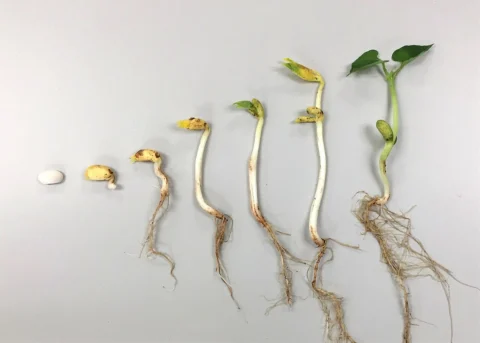

From the Namibian discussions
Namibian growers described collecting, exchanging and mixing seed for planting. Keeping those lots identifiable makes the effort more useful: a mixture that germinates poorly is difficult to diagnose if nobody knows which seed failed.
Take a representative sample
Extension seed-testing guidance uses a counted sample on a moist paper towel. Select seed without choosing only the largest or best-looking examples. For a household check, 20 seeds gives a rough indication; precious small lots may need a smaller sample and a more cautious interpretation.
Run and label the test
- Write the crop, variety if known, harvest year and test date on the label.
- Place the counted seeds on clean damp paper, keeping them moist but not submerged.
- Maintain conditions suitable for that crop and inspect regularly for normal seedlings and mould.
- Allow the crop’s expected germination period, then record normal seedlings, failed seed and any uncertainty.
Calculate clearly
If 16 of 20 seeds produce normal seedlings, the observed germination is 80%. That is a small-sample result, not a laboratory certificate. For 40 intended plants, 40 ÷ 0.8 gives 50 seeds before allowing for field losses. Do not simply add 20% and assume the arithmetic guarantees 40 plants.
Use the result sensibly
Keep a useful lot cool, dry and labelled. A poor result may justify retesting under better conditions or replacing the seed rather than sowing much more into a water-limited bed. Share the test date and result when exchanging seed, and keep suspect or mouldy lots separate.
Namibian climate and microclimate
Heat and humidity in storage can affect viability, and paper can dry quickly during a test. A good indoor result still needs suitable sowing depth, soil temperature and moisture outdoors. Compare subsequent field emergence with your test.
Your first practical step
Test one saved lot before the next planting and write the result on its packet, including the sample size and date.
Watch and adapt
Publisher: ABC Gardening Australia
Country and context: Australia; exact filming location not confirmed.
A practical seed-raising lesson. Adapt light, watering and timing to your seed species and Namibian microclimate.
Use the seed lesson for handling and labelling. The test described here is a household estimate, not a commercial seed-certification procedure.
Keep exploring
- Saving seeds
- Organise a seed exchange that carries the growing knowledge too
- Seed priming: test controlled soaking without the myths
Sources and further reading
Have you tried this in Namibia? Share the site conditions, method and result—including what did not work—with the Living Earth community. Local observations help the next person adapt the idea.