
Kiwano or horned melon, Cucumis metuliferus, is an African climbing crop with a spiny fruit and jelly-like interior. Local seed knowledge and household uses are good starting points for deciding whether to grow it.
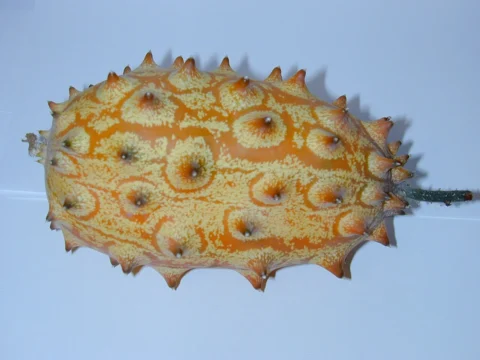
Photo: Forest and Kim Starr · Original image · CC BY 3.0 us. Wikimedia display-size version; no crop or content edits.
.jpg)
From the Namibian discussions
In the saved discussion, a contributor described seeing many fruits in Rundu, others shared examples in Windhoek, and one reported making juice. Participants asked for seed and training. These are useful records of local interest and use; they do not establish the origin of every fruit or a yield comparison. The discussion also used the name “Omanyoshe”; ask local speakers and growers about their usage.
Where it fits
SANBI records the species in Namibia and describes an annual climber of well-drained sites. For a home garden, choose known edible planting material from a trusted grower and reserve enough space for the vine. A local wild fruit should not be identified as edible from a photograph alone.
Start with seed and a support
- Ask the seed grower where and when the parent crop was grown.
- Choose a warm, locally suitable growing period and a well-drained site.
- Provide room to trail or a stable support that you can reach for harvest.
- Label seed lots and record emergence, flowering and fruit set.
SANBI recommends regular watering during cultivation. Its account also notes possible mildew and whitefly problems; native occurrence does not make a cultivated crop immune to pests.
Explore the food use
Ask experienced households how they select ripe fruit and prepare it. Test a small quantity of a known edible cultivar before planting for a market. Do not use unfamiliar, bitter wild cucurbits as food or assume that cooking removes their risks.
Make a worthwhile comparison
Compare one or two planting positions, keeping the seed source and care similar. Measure harvest in kilograms as well as the number of fruit. Note losses and preparation time, since useful production depends on what people actually eat or buy.
Namibian conditions and microclimate
Rundu and Windhoek differ in temperature, rain and frost exposure. A sheltered courtyard and an open field in the same town also differ. Record wind, afternoon heat and irrigation rather than using “grows in Namibia” as a complete planting instruction.
Try it locally and share what happens
Find a local grower, confirm the edible seed source and start with a few plants. Share the variety or source, planting date, litres of irrigation and preferred food use with your results.
Watch, understand, adapt
Post Summer Prep and Plant
Country and context: Australia — ABC Gardening Australia, Perth, Western Australia.
A supporting lesson on preparing and rotating vegetable beds, rather than a kiwano tutorial.
Apply it locally: Perth’s winter-rainfall calendar is different. Use the planning method with your local warm season and remember that kiwano belongs to the cucurbit family.
Keep exploring
Cucumbers · Saving seeds · Crop rotation