
Roots work with living partners, but the partnerships are not all the same. Mycorrhizal fungi and nitrogen-fixing bacteria perform different jobs and require compatible plants and suitable conditions. Understanding the difference helps you care for soil and judge inoculant claims.

From the Namibian discussions
Namibian discussions connected tree growth with fungi, compatible bacteria and soil conditions. Another shared list suggested local legumes as possible soil improvers. These are useful questions, but a plant’s membership of the legume family does not prove that it fixes nitrogen in a particular field. A contributor also reported that a microbial collection attempt worked only during a wet spell; that observation does not identify the organisms collected.
Distinguish the two partnerships
Mycorrhizal fungi associate with plant roots and can assist access to soil nutrients and water, receiving carbon from the plant. They do not create phosphorus from nothing. Different types associate with different hosts, and some crops, including many brassicas, do not form the usual mycorrhizal partnership.
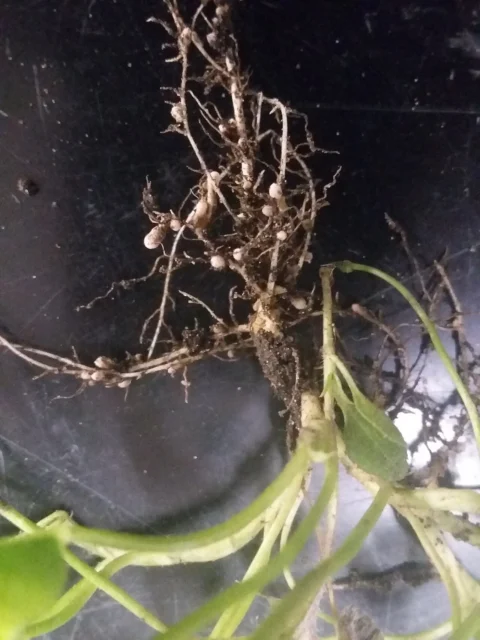
Rhizobia are bacteria that form nitrogen-fixing nodules with compatible legumes. This is distinct from mycorrhiza. A legume can require a particular bacterial partner, and fixation depends on the plant and growing conditions. Do not describe every legume or every root swelling as evidence of useful nitrogen fixation.
Begin with plant and soil conditions
Confirm the crop or tree identity and look for ordinary constraints first: water stress, poor drainage, unsuitable pH, nutrient shortage or damaged roots. Adding microorganisms cannot replace a workable rooting environment. Use soil information to guide amendments rather than buying several biological products at once.
Keep suitable living roots and ground cover where water permits, manage disturbance thoughtfully and return appropriate organic matter. These are practical soil-management choices that can be assessed through plant performance and soil condition. They are not a guarantee that every purchased organism will establish.
Inspect legumes without overclaiming
Carefully lift a representative plant with surrounding soil rather than pulling off the roots. Photograph the root system and any nodules. Record crop identity, growth stage, inoculation history and field conditions. If you need to assess nodulation or nitrogen contribution, seek crop-specific advice; one photograph cannot quantify the nitrogen available to the next crop.
Keep local wild-legume observations separate from recommendations for food, fodder or seed collection. Correct identification, conservation status and suitability matter. An attractive online species list is not a planting plan, especially when a species is rare, poorly understood or potentially toxic.
Choose an inoculant only for a clear purpose
For a legume inoculant, confirm compatibility with the crop and follow storage, expiry and application instructions. For mycorrhizal products, ask which organisms are present, which hosts they suit and what evidence supports use in comparable conditions. Native soil communities may already provide the relevant partners.
Avoid moving soil from another farm simply because its trees look healthy. That can move pests, weeds and pathogens as well as microorganisms. A labelled, appropriate product and a limited comparison are easier to interpret than an unidentified mixture brought from elsewhere.
Make a useful local comparison
- Choose the same crop, soil preparation and watering for treated and untreated areas.
- Repeat the comparison in more than one small position so a shady corner does not decide the result.
- Record establishment, growth, harvest, water and product cost in NAD.
- Report the conditions and unsuccessful outcomes along with any improvement.
Do not infer the mechanism from a greener plant alone. A product may also contain nutrients or other ingredients. Keep its label and describe the result accurately: what was applied, where and what changed. That makes local experience useful for the next grower.
Namibian climate and microclimate
Namibian soils, rainfall and irrigation conditions vary greatly. A moisture-dependent biological process can behave differently in a dry exposed bed and a mulched, irrigated root zone. Establishment water and a suitable host may matter more than the enthusiasm of a product demonstration.
Your first practical step
Choose one familiar legume or tree and document its soil, roots and growth before deciding whether an inoculant addresses an actual gap.
Watch and adapt
Watch: Mycorrhizae: introductory film linked for laboratory review
Publisher: University of Minnesota teaching-resource page; film linked on Vimeo
Country and context: USA-based university resource; film location not confirmed.
Open the video link under the laboratory-review heading. It illustrates the fungal partnership, not the performance of a specific inoculant.
The university-linked film introduces mycorrhizae. It does not demonstrate that a commercial inoculant will improve a Namibian crop, and it should not be used as a rhizobial product guide.
Keep exploring
Sources and further reading
Have you tried this in Namibia? Share the site conditions, method and result—including what did not work—with the Living Earth community. Local observations help the next person adapt the idea.