
Silage preserves suitable moist forage through controlled fermentation with air excluded. It can form part of a livestock feed reserve, but growing, harvesting, sealing and feeding it must work as one system. Begin with the animals’ needs and the quantity you can handle well.

From the Namibian discussions
The saved Namibian discussion included a silage supplier lead. It did not document feed composition, a feeding result or a recommended ration. Treat that lead as a reminder to ask about quality and storage, rather than as proof that any available silage is suitable for your animals.
Decide whether silage fits your farm
Compare silage with dry hay, standing forage and purchased feed. Silage involves handling water as well as nutrients, and it needs sound storage and regular feed-out once opened. A large store can be a poor fit for a small herd if the exposed material is used too slowly.
Write down animal numbers, production stage and the period the reserve must cover. Have the ration assessed with the other feeds and minerals available. Silage is an ingredient, not automatically a complete diet. Include harvesting, transport, storage losses, labour and testing in the cost in NAD.
Harvest for the chosen storage system
Use a suitable forage crop and assess its maturity and moisture before harvest. Correct moisture, chop characteristics, packing and a prompt seal determine how well the material stores. Targets differ between chopped maize, grass silage and wrapped bales; obtain crop- and system-specific guidance rather than applying one moisture figure to all of them.
Organise equipment, people and covering material before cutting. Keep soil, manure and other contamination out of the forage. Do not assume an inoculant can rescue material harvested in unsuitable condition. University guidance highlights moisture and exclusion of oxygen as central to limiting losses.
Fill, compact and seal promptly
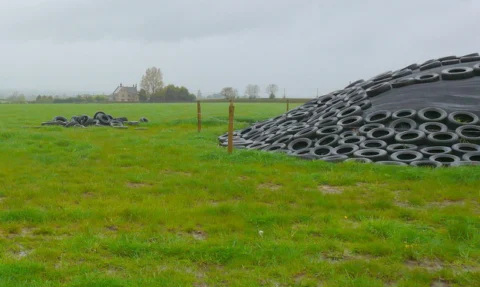
Prepare a drained, accessible site where runoff and effluent can be managed. The storage structure, loading machinery and working method need to suit each other. Pack and seal according to the chosen system, then inspect coverings and repair damage promptly. Protect wrapped bales from punctures and keep a record of the lot and harvest date.
Large piles, machinery and confined silos create serious working hazards. Keep people clear of unstable faces and machinery routes, and do not enter a silo or enclosed storage space to investigate fermentation gases. Plan a safe method with experienced operators rather than improvising after the crop arrives.
Check the feed before using it
Take representative samples following a forage laboratory’s instructions. Ask for the analyses needed for ration formulation and any specific risks in the crop. Drought-stressed forage may require nitrate testing. Fermentation can reduce nitrate concentrations, but it is not a guarantee that the resulting feed is safe.
Keep visibly spoiled, mouldy or suspect material out of the ration pending assessment. Appearance and smell can reveal a problem but cannot establish the full nutritional or safety profile. If animals refuse feed or become ill, stop using the suspect lot and seek veterinary advice.
Manage the opened store
- Match the storage size to a realistic daily feed-out rate.
- Keep the exposed face orderly using an appropriate safe method.
- Record the amount offered, refusals and obvious spoilage.
- Protect the remaining seal and inspect for new damage.
Introduce a new feed through an appropriate ration plan. Evaluate animal condition and production alongside feed consumption. When buying silage, request the crop, harvest date, storage history and analysis, and clarify whether the price refers to fresh mass or dry matter. Comparing only price per wet kilogram can be misleading.
Namibian climate and microclimate
Namibian heat can make exposed feed deteriorate quickly, while water scarcity affects the cost of growing the forage in the first place. Plan for wind damage to covers, transport distances and seasonal labour. The most practical reserve is one you can produce or buy, protect and feed consistently.
Your first practical step
Calculate the reserve period and daily requirement with an adviser, then compare a manageable silage lot against your other feed options before committing to a large store.
Watch and adapt
Watch: How to take a forage sample
Publisher: University of Minnesota Extension
Country and context: USA; Minnesota forage-production context.
The university article includes a forage-sampling film. It supports quality testing, rather than demonstrating the complete ensiling process.
The Minnesota sampling lesson supports feed testing; it is not a complete silage-making demonstration. Adapt sampling to the actual feed and laboratory, and production to Namibian conditions.
Keep exploring
Sources and further reading
- University of Minnesota: limiting hay and silage storage losses
- Iowa State University: weather-damaged maize for silage
- University of Minnesota: forage testing
Have you tried this in Namibia? Share the site conditions, method and result—including what did not work—with the Living Earth community. Local observations help the next person adapt the idea.