
A dry toilet can reduce flushing-water demand, but a good system must also contain waste, serve its users and provide a safe maintenance and treatment route. The toilet, storage, emptying and final destination belong in one plan from the beginning.
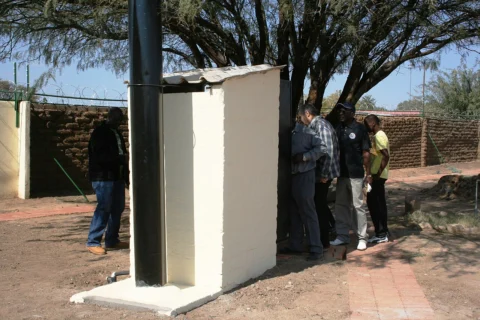
.jpg)
From the Namibian discussions
A Namibian discussion considered a toilet for a community growing site and shared positive experience with dry toilets at a campsite. A contributor also reported less odour with an EM spray. That is a local operating observation, not evidence that the contents were sanitised. The proposed pit dimensions in the discussion do not by themselves define an Otji or composting system.
Distinguish the systems
“Dry” means that flushing water is not used in the usual way; it does not specify how pathogens are controlled. A ventilated pit, a container-based drying system, a urine-diverting toilet and a managed composting chamber are different arrangements. Their liquids, solids and maintenance requirements differ.
The Clay House Project’s Otji manual describes a particular Namibian design with containers, ventilation and a sun-exposed drying arrangement. Use the actual design documentation and competent local advice rather than applying the Otji name to any pit with a vent. Versions and site conditions need to be checked.
Start with users and the site
Discuss privacy, access, cleaning, menstrual hygiene, children’s needs and handwashing with the people who will use the toilet. A technically interesting system that people cannot use comfortably will not function as intended. Provide clear instructions in appropriate languages and decide who keeps supplies available.
Assess groundwater, flooding, soil and nearby water sources with the responsible local specialists. A low-water design can still contaminate water if liquids infiltrate in an unsuitable place. Do not assume that Namibia’s dry climate makes every site appropriate.
Plan the full service chain
WHO sanitation-safety planning follows the chain from the toilet through containment, handling, treatment and final use or disposal. Identify who performs each task, what equipment they need and where the material goes. A sealed drawing of the toilet cubicle is not a complete service plan.
Make emptying access part of the layout. Budget cleaning, protective equipment, replacement parts and labour in NAD. Agree what happens if the regular operator is absent or the system fills sooner than expected. At a public or community site, responsibility should be explicit rather than assumed.
Operate the chosen design consistently
- Follow the system’s instructions for permitted inputs and cleaning.
- Keep ventilation, access and the intended drying or treatment conditions functioning.
- Maintain a handwashing facility and keep children away from stored waste.
- Record inspections, faults and maintenance so problems are addressed early.
Odour and flies are useful signs to investigate, but their absence does not prove pathogen removal. Additives are not a substitute for the required treatment process. Do not mix operating instructions from several different toilet designs into an improvised system.
Separate nutrient-recycling interest from safe reuse
Humanure writing encourages people to think about nutrient cycles, but handling human waste requires a validated process and local sanitation guidance. Dry-looking or partly decomposed contents should not be spread in a food garden on the assumption that they are safe.
Before proposing reuse, establish the treatment requirements, monitoring, storage and permitted end use with qualified sanitation personnel. Where a safe reuse route is unavailable, plan appropriate disposal instead. The practical success of a dry toilet includes what happens after the material leaves the cubicle.
Namibian climate and microclimate
The Otji concept has Namibian origins, but sun exposure, coastal humidity, groundwater, flood risk and usage rate vary by site. Drying and composting are not interchangeable processes. An arid climate can help some designs while also limiting water for cleaning and handwashing, which still need provision.
Your first practical step
Visit a functioning local installation and ask the operator to explain a complete maintenance cycle, including emptying and final handling. Use that information to prepare a site-specific sanitation plan.
Watch and adapt
Watch: Dry toilet — the Otji toilet
Publisher: EcoSur
Country and context: Namibian-origin toilet system; filming location not confirmed on the page.
English presentation with Spanish subtitles. Read the Otji documentation and plan the complete maintenance and sanitation chain.
The linked EcoSur film presents the Otji toilet in English with Spanish subtitles. The design originates in Namibia; the page does not establish every filming location. Use it as an introduction alongside the manual and local assessment.
Keep exploring
Sources and further reading
- Clay House Project: Otji toilet manual
- WHO: sanitation safety planning
- SuSanA: Otji toilet pilot in Namibia
Have you tried this in Namibia? Share the site conditions, method and result—including what did not work—with the Living Earth community. Local observations help the next person adapt the idea.