
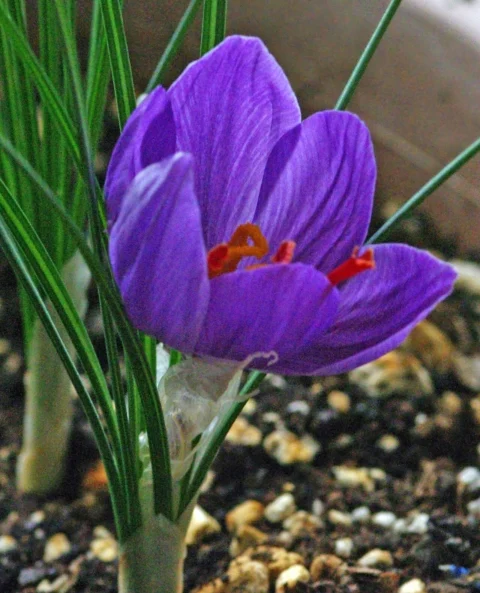
Saffron comes from the red stigmas of Crocus sativus flowers. It is a specialised crop with considerable hand labour. Before treating it as a high-value business, learn the plant’s seasonal cycle and prove that it flowers reliably at your site.

From the Namibian discussions
A Namibian grower asked about planting material obtained in Morocco for trials in Windhoek and on a farm. The discussion immediately questioned whether it was seed or a bulb. That distinction is useful: commercial saffron is propagated from corms, and material sold vaguely as “saffron seed” needs verification.
Buy the right material
The University of Vermont’s saffron work uses labelled Crocus sativus corms and compares different growing systems. Request species identity, corm size, health and provenance. Do not identify an edible spice by a purple flower alone; other crocus-like plants are not substitutes. Follow current plant-import requirements when sourcing outside Namibia.
Set up a manageable trial
- Choose a small, labelled, well-drained planting area and a supplier-supported seasonal planting plan.
- Record corm number and size, planting date, soil condition and any pre-planting losses.
- Keep watering records through leaf growth and dormancy. Do not keep dormant corms continually wet simply because the surface looks dry.
- Record flowers, usable stigmas, corm survival and the time spent harvesting and processing.
Do the labour calculation early
A high selling price per kilogram can be misleading when the harvest is tiny and each flower needs attention. Measure actual dried output using a suitable accurate scale. Record packaging, testing, rejected material and the labour required on flowering days. Confirm a buyer’s quality requirements before expanding.
Handle the crop carefully
Use clean harvesting tools and food-contact surfaces. Follow a validated saffron drying and storage method from a production specialist rather than guessing from colour or aroma. Keep lots labelled by harvest date. Do not make medicinal promises or assume that every imported corm will produce saleable spice in its first season.
Namibian climate and microclimate
Vermont research takes place in a cold temperate climate, often with protected cultivation. Namibia’s rainfall season, winter temperature, heat and irrigation differ. Compare Windhoek and a farm trial separately rather than combining their results.
Your first practical step
Obtain a small number of verified corms and a written seasonal care plan. Decide what a successful first season would teach, even if the spice harvest is modest.
Watch and adapt
 Watch videoWatch: 7,000 saffron corms
Publisher: University of Vermont Entomology & Saffron Research
Country and context: USA; Vermont research context.
Observe the handling and planting workflow. Vermont has a much colder, wetter climate and the opposite seasonal calendar to Namibia.
Watch the handling and planting workflow. Convert any imperial measurements to metric and choose timing and depth with local soil and temperature conditions in mind.
Keep exploring
Sources and further reading
- University of Vermont: saffron research and resources
- University of Vermont: saffron planting factsheet
Have you tried this in Namibia? Share the site conditions, method and result—including what did not work—with the Living Earth community. Local observations help the next person adapt the idea.