
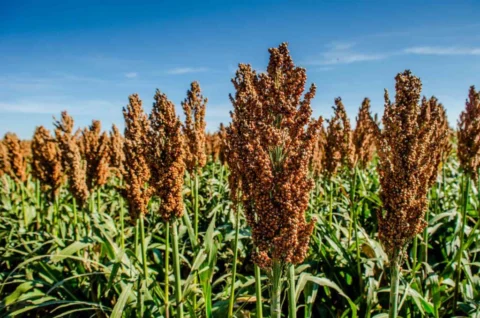
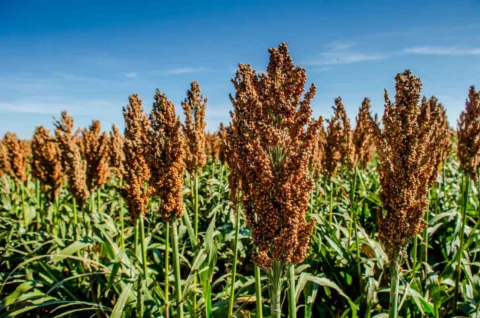
Sweet Sorghum (Sorghum bicolor) is a special type of sorghum grown for its juicy stalks as well as its grains. It is called God Jawari in parts of India. Unlike normal grain sorghum, sweet sorghum contains high amounts of sugar in its stems, which can be used for food, fuel, and livestock feed. Because of its ability to grow in hot, dry areas with little water, it is often called a drought-resilient multipurpose crop.
Why Sweet Sorghum Matters
Sweet Sorghum is sometimes described as a “3-in-1” crop because it provides:
- Food – nutritious grains that can be eaten as porridge, flour, or traditional dishes.
- Energy – sugary juice from the stalks can be pressed and fermented into ethanol, a renewable fuel.
- Feed – the leftover stalk (bagasse) and leaves can be fed to animals.
This makes it valuable in countries facing climate change, food insecurity, and rising fuel prices.
Growing Sweet Sorghum
- Crop cycle: It matures in about 4 months (120 days).
- Water use: Needs about half the water of sugarcane.
- Seasons: Can be grown twice a year, giving faster income returns to farmers.
- Soils: Grows even in poor or sandy soils, where maize and sugarcane struggle.
In two harvests, sweet sorghum can give more profit than one cycle of sugarcane, with lower input costs.
Benefits for Farmers and Communities
1. Food Security
The grains are a good source of energy, protein, and micronutrients. In parts of Africa, sorghum is already a staple food, and sweet sorghum varieties can fit into the same diets.
2. Energy Security
The juice from stalks is used to make ethanol, which can be blended with petrol for cars, used for cooking, or sold to industry. This reduces dependence on imported fossil fuels.
3. Livestock Feed
The bagasse (fibrous stalks after pressing) and green leaves are valuable animal feed, especially during drought when grass is scarce. This supports cattle, goats, and sheep farmers.
4. Environmental Benefits
- Drought resilience: Survives in low rainfall areas.
- Soil health: Roots improve soil structure and reduce erosion.
- Climate smart: Produces renewable energy and reduces greenhouse gas emissions.
5. Rural Income and Jobs
Farmers can earn money from multiple products (grain, juice, fodder), while ethanol processing plants and animal feed businesses create new jobs in rural areas.
Global Experiences
- India: The International Crops Research Institute for the Semi-Arid Tropics (ICRISAT) promotes sweet sorghum as a biofuel crop that also helps smallholder farmers.
- China: Large-scale research programmes have developed high-yield varieties for bioethanol production, showing the potential of sweet sorghum to reduce oil imports.
- Africa: Trials in Ethiopia, Sudan, and Mozambique show strong results in dryland areas, where sweet sorghum provides both food and renewable energy options.
- United States: Sweet sorghum is considered a potential biofuel crop, with government-supported research into its ethanol yields.
Sweet Sorghum in Namibia
Namibia faces low rainfall, frequent droughts, and heavy reliance on food and fuel imports. Sweet Sorghum could play a key role by:
- Supplying nutritious food grain for local households.
- Providing fodder to reduce livestock deaths during drought.
- Offering a renewable source of energy through ethanol production.
- Helping smallholder farmers diversify beyond maize and millet.
Community projects could link farmers, biofuel processors, and livestock keepers to create a new green economy around this crop.
Challenges
- Processing facilities: Ethanol plants are needed to convert juice into fuel.
- Storage: Juice needs to be processed quickly, so infrastructure must be close to farms.
- Market development: Policies and support are needed for ethanol use in vehicles and stoves.
- Research: More work is needed to adapt the best sweet sorghum varieties for Namibian soils and climate.
Learn More
- ICRISAT – Sweet Sorghum for Bioethanol
- FAO Sorghum Fact Sheet
- U.S. Department of Energy – Bioenergy Crops
- CGIAR Research on Sorghum
👉 Summary: Sweet Sorghum (God Jawari) is a short-duration, drought-tolerant crop that provides food, fuel, and fodder. It uses less water than sugarcane, grows in poor soils, and gives farmers higher profits in dry areas. With the right support, it can help Namibia and other African countries face challenges of hunger, energy shortages, and climate change.
Got it — if your keyword density is too high (probably for “sweet sorghum”), the trick is to add more general supporting text around related themes: biofuels, climate change, dryland crops, sustainable farming, etc., without repeating the keyword too often. Here’s a long additional section you can paste at the bottom of your article:
Wider Context and Future Opportunities
Across the world, many farming systems are under stress from climate change, water shortages, and rising input costs. Farmers are looking for crops that are flexible, fast-growing, and able to survive in tough conditions. One of the biggest opportunities lies in promoting multi-use plants that do not serve only one purpose but can give value in several ways. When a crop can provide food, energy, and livestock feed, it reduces risks for farmers and makes agriculture more resilient.
Developing bioenergy crops is also part of a larger movement to reduce reliance on fossil fuels. By producing ethanol locally, countries can cut fuel import bills, lower greenhouse gas emissions, and keep more value within rural communities. This can also create jobs in processing, transport, and marketing. In regions with large rural populations, such industries are vital to slow down migration to cities and to support village economies.
Another important aspect is the role of dryland cereals in food security. For centuries, communities in Africa and Asia have depended on hardy grains such as millet, sorghum, and barley to survive in semi-arid climates. These grains are naturally rich in nutrients and well adapted to soils that are too poor for maize or wheat. As global diets shift and food imports rise in cost, there is renewed interest in bringing back these traditional grains, both for health and for resilience.
Farmers also benefit when crop residues can be turned into useful by-products. Stalks and leaves can be used for animal feed, mulching, or even as a base for biogas production. This “circular farming approach” means that nothing is wasted. It also connects crop production with livestock management, which is the backbone of rural livelihoods in Namibia and many other countries.
The future of sustainable agriculture will likely depend on building integrated systems where food, energy, and ecosystems are linked together. This involves not only new crops but also supportive policies, farmer training, and access to markets. International organisations such as the Food and Agriculture Organization (FAO) and CGIAR are already promoting these ideas, and there is growing evidence that they can transform rural communities.