
Bambara groundnut (Vigna subterranea) is an African grain legume with edible seeds in underground pods. It deserves attention as part of a diverse food garden. Drought tolerance makes it worth investigating; it does not guarantee a harvest without sufficient moisture. IITA describes its use in semi-arid farming demonstrations in Tanzania.
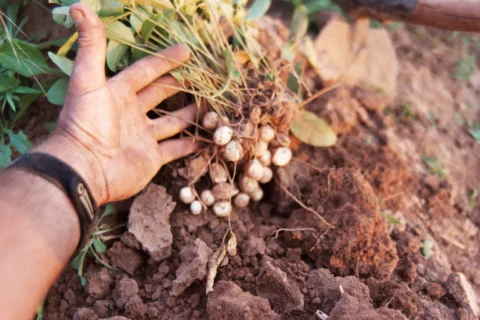
Photo: Kkibumba · Original photograph · Public domain. Unchanged; displayed at reduced size.

Local experience — Namibia
Local names shared in Namibia
A saved Namibian group contribution gives the Oshiwambo names “Eefukwa/Oofukwa” for Bambara groundnuts. Retain these as locally shared names; ask growers which spelling and language variety they use. The saved messages do not include a measured yield or watering record. Seed sharing and cooking experience from local households can help shape the first planting.
Where it fits
Consider a small bed or short row before setting aside a large field. Ask nearby growers which seed they use, when they sow and how they cook the harvest. Keep different seed lots labelled. A seed that performs well elsewhere in Africa still needs to prove itself in your soil, season and household.
What you need
- Sound, correctly identified seed and a labelled planting area.
- A sunny site with loose, well-drained soil.
- A way to water during establishment and unexpected dry spells.
- A notebook, a digging fork and a dry place for handling the harvest.
Establish the trial
- Choose a warm planting window with enough growing time before cold weather. Use local advice instead of copying a South African calendar.
- Remove competing weeds and prepare a friable seedbed. The South African production guide gives within-row spacing of 10–15 cm and row spacing of 45–90 cm; choose within that range with the seed supplier, allowing room to work.
- Sow into moisture. Planting depth depends on soil: the same guide gives about 5–7.5 cm for sandy soil and shallower planting for heavier soil. Avoid a waterlogged site.
- Label the sowing date and count emerged plants. Weed early, taking care around developing underground pods.
- Lift a few plants when the crop approaches maturity to inspect the pods before deciding when to harvest the rest.
South African production guidance is a regional starting point, not a Namibia-wide prescription.
Water and microclimate
Make a simple trial record: rain received, litres of supplementary water applied, emergence, flowering and harvest. Compare a wind-exposed edge with a sheltered part of the same bed. If one area stays wetter after watering, record it separately. A useful local result includes how much water and work the harvest required, not only whether the plants survived.
Harvest, kitchen use and common mistakes
Discuss the intended food use before expanding production. Research with households in Zimbabwe found that processing and cooking requirements influence Bambara use; hard-to-cook seed can make fuel and preparation time important. Try a small cooked batch and record those costs alongside the garden results. Zimbabwe processing study.
Do not assume that a legume replaces every soil nutrient removed at harvest, or that all seed colours have identical growing and cooking qualities. Keep seed identities and results separate.
Try this today
Speak to one local grower and choose a trial small enough to water reliably. Agree in advance how you will measure success: food your household enjoys, seed saved, water used and labour needed.
Watch, understand, adapt
On-farm soil sampling
Source and location: International Center for Biosaline Agriculture, based in Dubai, United Arab Emirates. The exact filming location is not stated.
A supporting skill for checking a new growing site. This is a soil-sampling demonstration, rather than a Bambara production lesson.
▶ Watch at the original source
Adapt for Namibia: The dry-climate context is useful, but sample depth and the tests requested should follow your laboratory’s instructions. Keep visibly different soil areas separate; do not assume your salinity or fertility matches the demonstration.
Keep exploring
Soil · Beans · Crop rotation