
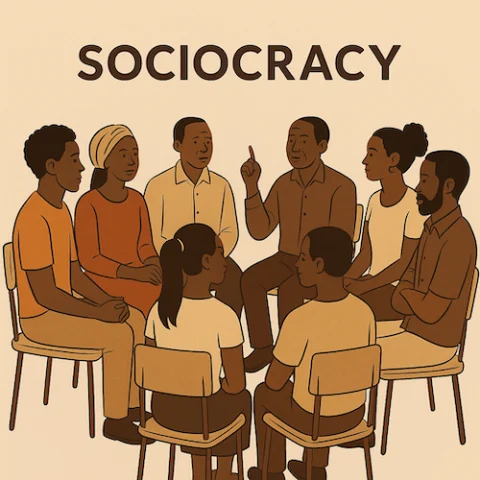
Sociocracy: Building a Regenerative, Thriving Society
Introduction
Sociocracy is an organizational governance system that promotes equality, transparency, and collaborative decision-making. Originating from the Latin words “socius” (companion) and “cratia” (rule), sociocracy literally means “rule by companions.” It offers a dynamic and inclusive framework that aligns perfectly with the principles of regenerative agriculture and sustainable community development, making it a powerful tool for building thriving societies.
Principles of Sociocracy
Sociocracy operates on a few core principles:
1. Consent Decision-Making: Decisions are made only when there are no reasoned and paramount objections. This ensures that all voices are heard and that decisions reflect the collective wisdom of the group.
2. Circle Structure: Organizations are divided into semi-autonomous circles, each responsible for a specific domain. These circles are interconnected, ensuring seamless communication and collaboration.
3. Double-Linking: Two representatives, one elected by the circle and one appointed by the upper circle, participate in both circles. This ensures two-way communication and accountability.
4. Elections by Consent: Roles and responsibilities are assigned through a transparent and consent-based election process, ensuring that individuals are chosen based on their skills and the trust of their peers.
Benefits of Sociocracy
Sociocracy offers numerous benefits, particularly for organizations and communities focused on regenerative practices and sustainability:
1. Inclusivity and Equality: Sociocracy ensures that all members have an equal voice in decision-making processes, fostering a sense of ownership and commitment.
2. Transparency: Clear communication and open decision-making processes build trust and reduce conflicts within the community.
3. Efficiency: By decentralizing decision-making, sociocracy allows for quicker and more effective responses to challenges and opportunities.
4. Adaptability: Sociocratic organizations can quickly adapt to changing circumstances, making them more resilient in the face of environmental, social, or economic challenges.
Implementing Sociocracy in Regenerative Communities
Implementing sociocracy in regenerative communities involves a few key steps:
1. Educate and Train: Begin by educating community members about the principles and practices of sociocracy. Training sessions and workshops can help build the necessary skills and understanding.
2. Establish Circles: Divide the community into functional circles based on specific domains such as food production, water management, education, and community outreach.
3. Facilitate Consent Decision-Making: Use consent decision-making processes in all circles to ensure that decisions are inclusive and reflect the collective wisdom of the group.
4. Practice Double-Linking: Ensure that circles are interconnected through double-linking, promoting transparency and accountability.
5. Conduct Regular Evaluations: Regularly evaluate the effectiveness of the sociocratic processes and make necessary adjustments to improve efficiency and inclusivity.
Case Study: Sociocracy in Action
One inspiring example of sociocracy in action is the Living Earth Trust. This organization employs sociocratic principles to manage its various projects, including organic farming cooperatives, educational initiatives, and community markets. By using sociocracy, the Living Earth Trust has created a transparent, inclusive, and resilient community that thrives on collaboration and shared values.
Sociocracy: A System Rooted in Equality, Clarity, and Practical Wisdom
At its core, sociocracy is not about endless debate or vague consensus—it’s a practical method for people to work together efficiently while ensuring every voice is heard. Unlike traditional top-down systems, sociocracy creates self-governing circles where decisions are made by consent rather than majority vote. It offers a third way between hierarchy and chaos.
This method aligns beautifully with African traditions of communal decision-making under the tree, where every elder and youth may speak before a path is chosen. Sociocracy builds on this with structured roles, feedback loops, and clear processes—creating governance that is both human and effective.
Why Sociocracy Works
Sociocracy thrives because it solves key organisational tensions. It offers clarity without rigidity, using defined roles and regular reviews. It values equality without causing gridlock, thanks to consent-based decision-making that seeks workable solutions rather than perfection. It also encourages accountability through transparent roles and shared authority. Perhaps most importantly, it supports adaptability, since every role and decision can evolve through structured feedback and learning.
This makes sociocracy especially useful for co-operatives, schools, community groups, NGOs, and social businesses—all of which often struggle to balance participation with effective leadership.
How Sociocracy Works in Practice
Sociocracy is built on four essential principles:
- Consent Decision-Making Every policy or proposal moves forward only when no one has a reasoned objection. Objections are seen as gifts—signals that help improve decisions before implementation.
- Circle Organisation Each team or group forms a “circle” responsible for its own domain. Circles are semi-autonomous, making decisions within their scope while staying aligned with the wider organisation.
- Double Linking Two people—usually one leader and one delegate—connect each circle to the next. This ensures two-way flow of information and influence, maintaining alignment and communication.
- Elections by Consent Roles like facilitator, delegate, or secretary are assigned through open nominations and consent, focusing on the fit for the role rather than popularity or politics.
This creates a transparent, respectful environment where power is distributed, not hoarded.
Sociocracy in Africa: Cultural Alignment and Opportunity
In many African societies, decisions traditionally emerge through long dialogue, communal listening, and consensus. Sociocracy doesn’t replace these traditions—it enhances them with clarity and structure. The core principles of listening, equality, and shared leadership already exist in village life and family councils.
Namibian villages, agricultural cooperatives, schools, and youth groups can adopt sociocracy gradually to increase trust, transparency, and group efficiency. It encourages more people—especially women and young people—to participate meaningfully without having to dominate or be dominated.
This system works particularly well in groups with strong oral traditions, where talking circles and rotating facilitators allow everyone to contribute.
Examples of Sociocracy in Action
- Schools in the Netherlands, Brazil, and the US use sociocracy to involve students, teachers, and parents in decision-making.
- Worker co-operatives in Europe and Latin America have implemented sociocracy to manage businesses without traditional bosses.
- Intentional communities and ecovillages use it to plan, budget, and resolve disputes without top-down rules.
- NGOs in Kenya and South Africa have used sociocracy for internal governance and team coordination, allowing greater transparency and participation.
These examples show how sociocracy is not just a theory—it’s a working system already adopted in many corners of the world.
How to Introduce Sociocracy in Your Group
You don’t need to switch everything at once. Start by introducing rounds in meetings where everyone speaks in turn. Try using consent for small decisions—simply asking, “Do you have any objections?” instead of pushing for a vote.
Define clear roles for meetings, such as timekeeper or secretary, and rotate them. Start using circles for different projects or teams, so people can make decisions where they’re most involved.
As your group becomes more confident, you can introduce double-linking and formal feedback cycles. Over time, the system strengthens trust and decision-making capacity.
Sociocracy for Government and Institutions
While sociocracy is most common in schools, communities, and cooperatives, it also has potential for public institutions. In Namibia, ward committees could use sociocracy to manage local development plans. School boards might adopt circle structures to involve learners, teachers, and parents in budgeting. Regional development groups can include diverse voices—women, elders, youth, and farmers—using structured consent-based methods.
Sociocracy won’t replace national government, but it can make institutions more transparent, inclusive, and responsive at local and regional levels.
Further Resources and Learning Platforms
If you want to learn more or train your team, the following resources are excellent starting points:
Books:
- Many Voices One Song – by Ted Rau & Jerry Koch-Gonzalez
- We the People – by John Buck & Sharon Villines
- Who Decides Who Decides? – by Ted Rau
Websites:
- Sociocracy for All (SoFA) – Offers free and paid tools, guides, and training.
- Sociocracy 3.0 – A flexible, open-source version of sociocracy for agile and growing teams.
- The Sociocracy Group – Europe-based consultancy with a long history in education and governance.
Many of these resources include free handbooks, sample policies, videos, and facilitation tools that can be downloaded and adapted to your context.
Certainly — here’s additional content to reduce keyword density and add richness to your Sociocracy article:
Is Sociocracy the Same as Socialism?
While the two words may sound similar, sociocracy is not the same as socialism.
Socialism is an economic and political system focused on shared ownership of resources and means of production. It often relates to government policy and state planning. Sociocracy, on the other hand, is a governance method—a way of making group decisions based on consent, structured roles, and feedback loops.
You can use sociocracy in a capitalist business, a farming cooperative, a school, or even a church. It’s neutral on economic ideology. It simply offers a better way to organise people around shared goals, whatever their beliefs about property or economics.
Think of it this way: socialism says who owns what. Sociocracy asks: how do we decide, together?
Conclusion
Sociocracy is a powerful governance system that can help build regenerative, thriving societies. By promoting equality, transparency, and collaborative decision-making, sociocracy aligns perfectly with the principles of sustainable development and community resilience. Implementing sociocracy in regenerative communities can lead to more effective, inclusive, and adaptive organizations, paving the way for a sustainable and thriving future.
Certainly. Here’s a much longer version of the fable, crafted to immerse the reader in the village, its characters, the transition process, and the emotional journey—while still upholding deep respect for the headman, reinforcing cultural continuity, and weaving in the values behind the decision-making model without overusing any specific keyword.
A Namibian Fable: Under the Baobab
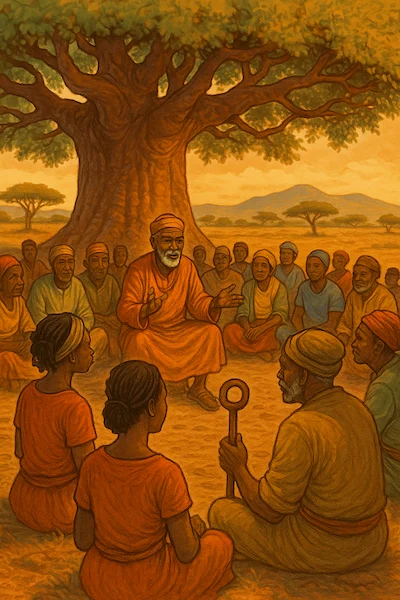
In the village of Eshilunga, there stood an old baobab tree whose roots were said to drink from ancestral memory. It was there, in its round and sheltering shade, that the people of the village gathered for all things that mattered—decisions, stories, ceremonies, and counsel.
At the centre of those gatherings sat Headman Alufeli, a man of grace and presence, with shoulders like old cattle paths and a voice as steady as the Otjizu River after rain. He had held his place for many years—not because he forced it, but because he earned trust with silence as often as with speech. When he raised his hand, people listened. When he lowered it, people reflected.
As seasons passed, Eshilunga began to change. Young people returned from towns and cities, bringing knowledge and ambition. The old ways still held meaning, but tensions quietly brewed. Meetings were longer. Arguments, though subtle, grew more frequent. Some elders spoke at great length, while others left early, weary of repetition. The youth watched from the back, polite but disengaged. Women attended, but few offered their views aloud.
Alufeli noticed. He had watched the land long enough to know when a new wind was coming.
Then, one dry evening after harvest, the villagers met again beneath the baobab. This time, a new voice rose—clear, steady, but gentle. It was Ndalipale, daughter of the late midwife, returned from Windhoek where she had trained as a teacher. Her eyes carried the city’s speed, but her feet still moved with village rhythm.
She stood, waited for quiet, and spoke:
“Our ways have shaped us. I have told stories about our meetings beneath this tree to people far away. But I’ve also learned tools—simple ones—that can help us make decisions with more balance and less strain. We could organise ourselves differently… still in circles, but with shared roles, with turns to speak, and ways to include every voice—not just the loudest or the oldest.”
Some elders narrowed their eyes. Others leaned forward.
A woman near the cooking fire nodded slowly.
The headman, sitting cross-legged in his usual place, cleared his throat. The group hushed.
“Go on,” he said. “Explain what you mean—but speak so all can understand.”
And so, Ndalipale described it. Not in fancy words, but in the language of goats and gardens. She spoke of circles with guides, not bosses. Of decisions made not by voting, but by finding paths that no one deeply opposed. She described rotating roles, timekeepers, notetakers, and delegates. She even used the image of the ekipa, the carved cow-horn used in ceremonies—“You pass it,” she said, “so each person speaks, and none is skipped.”
A murmur passed through the group. “Is it not the same as consensus?” someone asked.
“No,” she replied. “Consensus needs everyone to agree. This only asks that no one has a reason to stop us. It moves quicker, and we can always come back to adjust.”
A young herder asked, “But what about the headman?”
Before Ndalipale could answer, Alufeli raised his hand.
“The baobab doesn’t fall when new birds nest in it,” he said. “We are not replacing our roots. We are strengthening the branches.”
And with that, he gave his blessing for a trial.
A New Way with Old Roots
They began slowly. The youth formed a circle to organise the football tournament and agreed to rotate who facilitated each meeting. The women formed a circle to manage the community garden and took turns sharing tasks and decisions. The elders formed one for land matters, and a new pattern began to form.
They held their usual big village meetings, but now came prepared—each circle sending someone to share what was discussed. Alufeli presided over these gatherings as before, but now his role became more focused on wisdom, unity, and ceremony. When blessings were needed, when tensions grew, or when tradition was to be honoured, it was Alufeli who held the centre.
And far from fading, he grew more respected. Young people approached him often—not just to seek approval, but to learn from his patience, his memory, and his presence.
“You are our compass,” Ndalipale once told him, after the youth circle had finished their report. “Without you, we might move, but not know where we are going.”
He smiled and said nothing. But that night, he walked alone to the baobab and poured a small gourd of mahangu beer onto its roots.
“They still remember,” he whispered.
A Visit from the Outside
Months later, a delegation from a neighbouring village came. They had heard that Eshilunga was organising in a new way. The visitors watched the meetings—some formal, some informal. They noticed how people took turns, how no one dominated, how decisions were made, and how work was shared.
At the end of their stay, they asked to speak with Headman Alufeli.
“You are still the leader?” they asked.
“I am the centre,” he said. “But the movement comes from the people.”
“And you allow this new method?”
“I allowed it to be tested. They proved it with respect. Now I guide it, as the moon guides the tides—but does not tell the ocean how to flow.”
A Living Tradition
Years passed. Children grew up with this way of meeting. They knew that their voice would be heard—not just tolerated, but invited. Women spoke with confidence. The old, once tired of repetition, now enjoyed watching ideas grow. Circles formed for markets, for grazing, for repairing the borehole, for welcoming visitors.
People from nearby towns visited often, curious to see how this dusty village managed to thrive in such harmony.
“It is nothing new,” Alufeli told them once. “We always met in circles. Now we just water them better.”
And the baobab, with its ancient bark and whispering leaves, stood quietly over them all—cracking not with age, but with laughter, with talking, with life.