
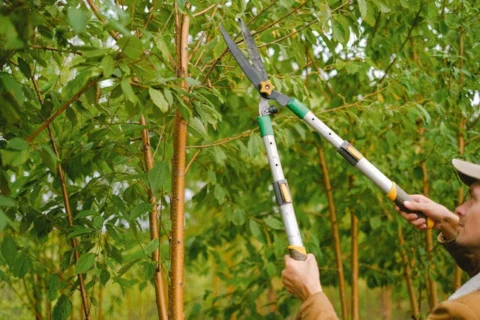
Pruning stimulates plant growth because it changes how the plant allocates its energy and hormones. Here’s how it works in simple terms:
Redirects Energy
- Plants have a limited amount of energy (from photosynthesis and stored reserves).
- When you remove certain branches or shoots, the plant no longer has to maintain them—so it redirects that energy into producing new growth (like buds, leaves, or fruit) elsewhere.
Reduces Apical Dominance
- The apical bud (the tip of the main stem) produces a hormone called auxin that suppresses the growth of lower buds.
- When you cut off that top bud, you reduce auxin levels and allow lateral buds to grow.
- This results in a bushier, fuller plant with more branches.
Improves Light and Air Circulation
- Removing dense or crossing branches opens up the canopy.
- Better light penetration and airflow stimulate photosynthesis and reduce disease, leading to stronger, healthier growth.
Encourages Renewal
- Pruning often removes old, weak, or diseased wood.
- The plant responds by producing new, vigorous shoots to replace what was lost, rejuvenating its overall structure.
Balances Roots and Shoots
- After pruning, the plant’s root system is still the same size, but the shoot system (above-ground part) is smaller.
- This imbalance triggers the plant to produce more shoots to restore equilibrium, driving rapid growth.
✅ In short:
Pruning stimulates growth because it removes growth inhibitors (like apical buds), redirects energy, and triggers the plant’s natural repair and regeneration mechanisms.
Why Pruning is Different in Namibia
Pruning in Namibia is not the same as pruning in Europe or wetter parts of Africa.
Our climate is:
- Hot
- Dry
- Windy
- High UV sunlight
- Low rainfall (often 100–400 mm per year)
Because of this, plants are already under stress. If we prune too much, we can weaken the plant instead of helping it.
In a wet country, strong pruning often causes strong regrowth.
In Namibia, strong pruning can cause:
- Sunburn on branches
- Water stress
- Slow recovery
- Dieback
- Pest attack
That is why pruning here must be gentle, strategic and water-wise.
Main Goals of Pruning in a Semi-Arid Climate
In Namibia, pruning should aim to:
- Reduce water loss
- Improve airflow without exposing the tree to harsh sun
- Remove dead or diseased wood
- Shape young trees carefully
- Prevent wind damage
- Balance growth and fruit production
We do NOT prune just to make trees look neat.
We prune to help the plant survive and stay productive.
When to Prune in Namibia
Timing is very important.
For most fruit trees:
- Prune in late winter, just before new growth starts.
- In central Namibia, this is usually July to early August.
Avoid:
- Heavy pruning in mid-summer.
- Pruning during extreme heat.
- Pruning during severe drought.
Light corrective pruning can be done at any time if you are only removing:
- Dead branches
- Broken branches
- Diseased wood
Light Pruning is Often Better Than Heavy Pruning
In dry climates, heavy pruning can shock the plant.
Instead:
- Remove no more than 20–30 percent of the canopy at one time.
- Spread major shaping over 2 to 3 seasons.
- Always leave enough leaves for photosynthesis.
Leaves are the plant’s solar panels.
If we remove too many, the plant cannot produce enough energy.
Sunburn – A Serious Risk in Namibia
After pruning, branches that were once shaded may suddenly face direct sun.
This can cause:
- Bark cracking
- Dry wounds
- Insect attack
- Fungal infection
To reduce sunburn risk:
- Avoid removing all inner branches.
- Leave some natural shading.
- On sensitive trees, you can paint exposed branches with diluted white natural clay or limewash.
Never leave large areas of bark exposed suddenly.
Pruning Young Trees
Young trees need shaping early.
Good early pruning:
- Creates strong branch structure
- Prevents future breakage
- Reduces future heavy pruning
For fruit trees:
- Choose 3–5 strong main branches.
- Remove weak or crossing branches.
- Keep an open but not exposed centre.
In windy areas like much of Namibia, strong structure is very important.
Pruning Mature Trees
Older trees should not be cut aggressively.
Focus on:
- Removing dead wood
- Removing branches rubbing against each other
- Opening very dense areas slightly
- Reducing height gradually if needed
If a tree is very overgrown, reduce it slowly over several years.
Pruning and Water Management
Pruning affects water use.
Light pruning:
- Can reduce water demand slightly.
- Helps the tree balance growth.
Heavy pruning:
- Often causes strong new shoots.
- These shoots use a lot of water.
- This can increase water stress.
In drought years, avoid strong pruning.
Tools for Pruning
Use clean, sharp tools:
- Hand secateurs for small branches
- Loppers for medium branches
- Pruning saw for thick branches
Always:
- Make clean cuts.
- Cut just above a bud or branch collar.
- Do not leave long stubs.
Clean tools between trees if disease is present.
Common Pruning Mistakes in Namibia
- Cutting too much at once
- Pruning during extreme heat
- Removing too much shade
- Ignoring wind direction
- Cutting flush against the trunk (damages healing tissue)
- Leaving large open wounds in summer
Remember: In our climate, less is often more.
Pruning for Regenerative Gardens
In a permaculture or regenerative system:
Pruning material should not be wasted.
You can:
- Use branches for mulch
- Use prunings for compost
- Make biochar
- Use small sticks for kindling
- Chop and drop under trees
Pruning becomes part of the nutrient cycle.
Nothing leaves the system.
Pruning Fruit Trees in Namibia
Each fruit tree species is different, but in general:
Stone fruits (like peaches and apricots):
- Fruit on new wood.
- Need annual light shaping.
Pome fruits (like apples and pears):
- Fruit on spurs.
- Need careful thinning of crowded branches.
Citrus:
- Usually need very light pruning.
- Focus mainly on removing dead wood.
You explain species-specific pruning in each plant entry, which is good for SEO and clarity.
Wind and Pruning
Wind is a major factor in Namibia.
Strong winds can:
- Break weak branches
- Cause rubbing damage
- Dry out wounds
When pruning:
- Keep trees balanced.
- Do not create one heavy side.
- Remove long, weak vertical shoots.
Wind protection through shelter belts is more important than aggressive pruning.
Linking to Helpful YouTube Videos
Search for:
- Living Web Farms – fruit tree pruning basics
- Huw Richards – pruning fruit trees simply
- Self Sufficient Me – practical backyard pruning
- Morag Gamble (Permaculture Education Institute) – regenerative orchard care
Search terms for linking:
- “Fruit tree pruning basics”
- “Pruning in dry climates”
- “How to prune peach tree”
- “Permaculture pruning”
Suggested External Articles to Link To
You can link to:
- FAO (Food and Agriculture Organization) resources on dryland agroforestry
- Articles on pruning in Mediterranean climates
- South African agricultural extension guides
- Dryland orchard management articles
Search terms:
- “Pruning in semi arid climates PDF”
- “Dryland fruit tree management”
- “Mediterranean orchard pruning guide”
Final Encouragement Section
Pruning is not about controlling nature.
It is about working with the plant.
In Namibia’s harsh climate, our role is to:
- Reduce stress
- Protect from sun
- Protect from wind
- Support long-term survival
- Encourage steady production
Prune gently.
Observe carefully.
Learn from each season.
Trees in drylands teach patience.
Worthwhile videos:

Living with Trees in a Hard Land
In some places, plants grow easily. Water comes often. Soil is deep and soft. Mist rises in the morning and leaves shine by midday.
But there are other places where every leaf has earned its place.
A dry landscape teaches different lessons.
Here, a tree does not grow simply because it can. It grows because it must. It measures its energy. It calculates risk. It stores strength quietly.
If you watch carefully, you will notice something special about trees that survive in harsh regions.
They are not rushed.
Their branches do not spread wildly without reason. Their leaves are not large without purpose. Their shape is not random. It is shaped by wind, heat, and years of negotiation with the environment.
When we begin working with such trees, we must first slow down.
Modern gardening culture often celebrates dramatic change. Before-and-after pictures. Fast transformation. Clean lines. Instant results.
But dryland ecosystems do not respond well to dramatic interference.
They reward patience.
They reward observation.
They reward restraint.
The Rhythm of the Seasons
In wetter climates, growth follows a simple pattern: rain, expansion, cutting back, new expansion.
In semi-arid regions, the rhythm is more complex.
Some years bring generous rain.
Other years bring almost none.
Some summers are bearable.
Others feel relentless.
Plants remember these cycles.
A tree that endured a drought last year may carry invisible stress into the next season. Cutting heavily during recovery can push it further into struggle.
This is why working with plants in a tough environment requires memory. Not just knowledge, but memory of recent seasons.
Ask yourself:
Was last year dry?
Did this tree fruit heavily?
Did late frost damage new growth?
Did wind break young shoots?
Every season leaves a mark.
Your decisions should respond to that history.
Strength Looks Different Here
In cooler, wetter countries, strength often appears as speed. Rapid vertical growth. Thick foliage. Large leaves.
In hot and dry areas, strength often appears as moderation.
Smaller leaves reduce water loss.
Denser wood resists breakage.
Lower growth reduces exposure.
What may look “untidy” to an outsider may actually be intelligent adaptation.
This does not mean you should never shape or guide a plant.
It means you should recognise the intelligence already present.
A branch growing slightly inward may be protecting the trunk from harsh afternoon sun.
A dense cluster of shoots may be shielding younger growth from wind.
A lower canopy may be reducing moisture loss from the soil surface.
Before removing something, consider what function it may be serving.
Working With Natural Design
Every plant species has its own architecture.
Some prefer an open structure.
Some naturally grow upright.
Some spread wide and low.
Some produce fruit on older wood.
Others on new growth.
Instead of forcing one ideal shape onto all species, learn the natural form first.
Walk through older farms in rural areas. Observe trees that have survived decades without professional shaping. Notice their patterns.
In many cases, you will see that long-lived trees in dry zones are not perfectly symmetrical. They lean slightly with the prevailing wind. They develop thicker bark on the sun-facing side. They grow stronger on one side than the other.
They adapt.
Your role is not to erase adaptation. It is to support it.
Energy, Not Just Appearance
A plant runs on stored energy.
Roots collect water and minerals. Leaves convert sunlight into food. Wood stores reserves for the next season.
When branches are removed, stored energy is removed as well.
If too much is taken away at once, the plant may respond with rapid, weak regrowth. That regrowth can look impressive at first, but it often requires more water and may be less stable.
Balanced shaping supports steady energy use.
Think of it like budgeting money.
If you spend everything at once, you create instability.
If you adjust gradually, you maintain balance.
Plants operate on a similar principle.
The Soil Beneath
In dry regions, the story is not only above ground.
Soil life is often fragile. Organic matter may be low. Microbial activity depends on moisture.
When branches and leaves are returned to the soil surface, they create shade, reduce evaporation and slowly increase fertility.
This means that cutting is not just about removing. It is also about redistributing.
Nothing should be wasted.
Smaller branches can be chopped and left beneath trees. Larger pieces can become mulch or biochar. Even leaves can be valuable protection for the soil surface.
In time, this slow return builds resilience below ground.
Healthy soil supports stable growth above ground.
Humility in Practice
Working in a harsh environment encourages humility.
You may do everything “correctly” and still face setbacks because of drought or extreme heat.
You may follow a perfect schedule and still lose branches to wind.
This does not mean failure.
It means you are working in a dynamic system.
Instead of trying to control every outcome, focus on supporting long-term stability.
Ask each year:
Is the tree healthier than before?
Is the soil improving?
Is the structure becoming stronger?
Small improvements compound over time.
A Long-Term View
In semi-arid regions, success is measured over decades, not months.
A tree that establishes deep roots and stable structure in its early years will serve for generations.
A tree that is pushed for rapid growth may decline early.
Think of your garden or orchard as a long conversation with the land.
Each season adds a sentence.
Each decision adds meaning.
You are not just shaping branches.
You are shaping the future resilience of your landscape.
Final Reflection
A dry climate is not a limitation. It is a teacher.
It teaches efficiency.
It teaches balance.
It teaches respect for natural limits.
When you stand beneath a mature tree that has survived many harsh summers, you are standing beneath accumulated wisdom.
Let your actions reflect that wisdom.
Work steadily.
Observe closely.
Adjust gently.
In time, you will notice something remarkable:
The land begins to respond.
Not dramatically.
Not instantly.
But faithfully.
And that quiet faithfulness is the foundation of long-term abundance in any hard place.
The Farmer Who Cut Too Much
A Story from a Dry Valley
There was once a young farmer who moved to a dry valley where the wind never truly rested and the sun ruled the sky for most of the year.
He had grown up in a green country far away. There, trees were thick and soft. Rain came often. Plants forgave mistakes quickly.
In his new valley, he planted peaches, pomegranates and a few young shade trees near his house. They survived the first year. They even grew.
But they did not grow like the trees of his childhood.
Their leaves were smaller. Their branches twisted slightly in the wind. Their bark felt tougher, almost defensive.
One winter, the young farmer decided it was time to “fix” them.
He had watched many videos. He had seen bold, confident gardeners cutting hard and shaping trees beautifully. He wanted neat structure. He wanted strong growth. He wanted results.
So he cut.
He removed crowded branches.
He opened the centre widely.
He shortened long limbs.
He stepped back proudly.
The trees looked clean. Perfect. Sculpted.
Then summer arrived.
The sun burned deeper into the orchard than ever before. Branches that had always lived in shade were suddenly exposed. The bark cracked. Sap oozed. Leaves wilted faster than usual.
New shoots came strongly at first, but they were soft. The wind snapped some of them. Others grew straight up, thin and thirsty.
The farmer watered more. But the soil was sandy in parts and heavy clay in others. Water did not stay evenly. The trees struggled.
One old neighbour watched quietly.
After some weeks, the neighbour walked over and said gently:
“You cut like a man from the north.”
The young farmer felt embarrassed. “Is that wrong?” he asked.
The neighbour smiled.
“Not wrong. Just from another place.”
They walked together between the trees.
The neighbour touched the cracked bark. He pointed to a branch that had once shaded another. He showed how the wind pushed from one direction almost every afternoon.
“These trees are not fighting you,” he said. “They are protecting themselves.”
The next winter, the young farmer tried again.
This time he removed only what was dead.
He shortened only what was clearly weak.
He kept inner branches that created soft shade.
He watched the wind before choosing which shoots to keep.
He noticed something new.
The trees did not need to be controlled. They needed to be understood.
Over the next seasons, growth became steadier. Not dramatic. Not explosive. But balanced.
Fruit came more reliably. Branches grew thicker before growing longer. The bark stayed healthy. The soil beneath the trees slowly improved as prunings were chopped and returned to the ground.
The young farmer realised something important:
In a harsh climate, survival is wisdom.
And wisdom should not be cut away.
The Lesson of the Valley
In dry landscapes, strength looks different.
It is not soft and fast.
It is slow and deliberate.
It protects itself.
When we remove too much at once, we may remove the plant’s own defence system.
When we open everything to the sun, we may create more stress than benefit.
When we chase perfect shape, we may forget function.
The valley teaches a different approach:
Remove what harms.
Guide what competes.
Protect what shields.
Balance rather than dominate.
A tree growing in heat and wind has already designed itself carefully. Our task is not to redesign it completely. Our task is to support it.
A Conversation with a Tree
If a tree in a dry land could speak, it might say:
“Do not make me naked before the summer.”
“Do not ask me to grow faster than my roots can drink.”
“Do not remove the branch that guards my trunk.”
“Help me stand strong against the wind.”
It might also say:
“Thank you for removing what is dead.”
“Thank you for shaping me when I was young.”
“Thank you for returning my branches to the soil.”
A Different Kind of Skill
Working with plants in tough conditions requires patience.
It requires observation.
It requires humility.
Sometimes the most skilled action is a small cut instead of a large one.
Sometimes the best decision is to wait until the next season.
Sometimes doing less creates more.
The Long View
In wetter regions, people speak about productivity first.
In dry regions, we must speak about resilience first.
Productivity follows resilience.
A tree that survives five harsh summers will produce more in the long run than one that grows quickly for two years and then declines.
This long view changes how we work.
It changes how we shape young trees.
It changes how we respond after a drought year.
It changes how we see “imperfection.”
The valley is not interested in perfect form.
It is interested in endurance.
Bringing the Story into Your Garden
When you stand in front of your own tree this winter, pause for a moment.
Look at:
- Which side faces the strongest sun
- Which direction the wind pushes from
- Where branches protect each other
- Where dead wood truly needs removal
Then cut with intention.
Not to impress.
Not to copy another climate.
But to support life where you are.
Over time, you will begin to see patterns. Some trees ask for very little shaping. Others need gentle guidance when young. Some seasons require almost no cutting at all.
You will notice that each year teaches something new.
And perhaps, like the young farmer, you will learn that working in a harsh landscape is less about control and more about partnership.
In the end, the trees of the valley did not become perfect.
They became strong.
And in a dry land, that is the greater success.