
Sourplums can contribute fruit, habitat and a thorny edge to a suitable landscape. Begin with the species: “Ximenia” and “sourplum” can refer to different plants. Large sourplum is now listed by SANBI as Ximenia afra, formerly Ximenia caffra; Ximenia americana is another species.
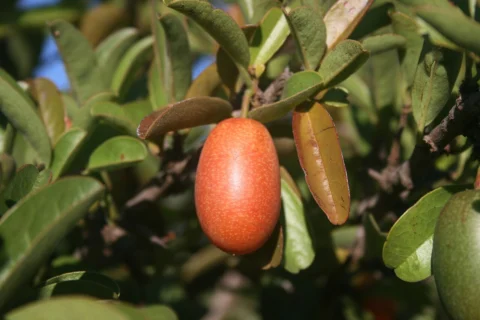

From the Namibian discussions
The Namibian planting list requested a Ximenia under an uncertain species spelling. This guide keeps that interest while avoiding an identification based on a misspelled name. Local knowledge of a particular fruiting shrub is valuable, especially when paired with photographs and a confirmed name.
Separate identification from use
Ask an experienced local plant specialist to confirm leaves, thorns and fruit together. SANBI describes ripe large-sourplum fruit as edible; that does not make every plant called sourplum interchangeable or every plant part edible. Seed oil and medicinal preparations are different subjects from eating the ripe fruit pulp. Do not turn a general species note into a home treatment recipe.
Allow for the plant’s relationships
SANBI notes that large sourplum is partly root-parasitic. An isolated pot is therefore not necessarily a fair test of how it performs among other vegetation. Ask a nursery how its stock was propagated and established. Retain useful neighbouring plants where appropriate rather than clearing the entire patch without understanding the site.
Try a small propagation record
- Use correctly identified, legally obtained ripe fruit and label the seed with its source and collection date.
- Follow a reliable species-specific nursery method; keep the medium draining freely and record germination rather than promising a date.
- Compare a few seedlings under manageable conditions, keeping all labels through transplanting.
- Protect the young plants from browsing and monitor moisture, leaf condition and growth. Keep failures in the record too.
Design a harvestable edge
Thorns need room beside paths, play areas and work spaces. Leave enough access to inspect the shrub and gather fruit without forcing people through it. If using sourplum in a mixed hedge, judge the species on survival, maintenance and usefulness at your site before committing the whole boundary. Do not assume a fruiting hedge is immediately stock-proof.
Namibian climate and microclimate
SANBI describes established large sourplum as drought tolerant with some frost tolerance. This is not a guarantee for seedlings in a cold hollow or a hot container. Compare local wild plants and check how shelter changes minimum temperatures and drying wind.
Your first practical step
Identify one local sourplum with help, record both its current and older scientific names, and observe a fruiting season before expanding.
Watch and adapt
 Watch videoWatch: Build a Nursery & Grow Trees
Publisher: Community Forests International
Country and context: Exact filming country not confirmed; Swahili with English subtitles.
A general seedling-care lesson, also catalogued by World Agroforestry. It is not a species-specific growing demonstration.
Use the nursery video for labelling and seedling care. It does not cover Ximenia’s root associations, so obtain species-specific advice before a propagation trial.
Keep exploring
Sources and further reading
Have you tried this in Namibia? Share the site conditions, method and result—including what did not work—with the Living Earth community. Local observations help the next person adapt the idea.