
Phosphorus is essential for plants, but that does not mean every struggling garden needs more. Soil chemistry, root health and water supply influence access to nutrients. Use a soil test and a crop question to decide whether an amendment is justified.
.jpg)
From the Namibian discussions
The saved collection contained broad advice about phosphorus shortages, bone products and livestock nutrition. It did not establish that a particular Namibian plot was deficient. This guide keeps the useful question about plant nutrition while separating it from animal feeding and unverified national generalisations.
Start with the crop problem
Record where poor growth occurs, when it began and whether irrigation or drainage changed. Leaf colour alone is not a reliable laboratory diagnosis. Compare affected and healthy areas and tell the laboratory about recent manure, compost or fertiliser applications.
Consider pH and the test method
University of Minnesota guidance explains that soil reactions influence phosphorus availability. The same total amount can behave differently under different conditions. Ask a local laboratory or agronomist to interpret the appropriate test for your soil, rather than comparing an unfamiliar number with an overseas chart.
Compare materials by analysis
Rock phosphate, bone meal, manure and manufactured fertilisers differ in concentration and availability. Read the product analysis and ask whether the value is stated as phosphorus or phosphate equivalent. Do not treat a low-cost material as economical until transport, application and expected response are included. Obtain a crop- and area-specific rate.
Keep a treatment record
- Write down the recommendation and the area to which it applies.
- Measure the material rather than estimating by handfuls.
- Keep it out of drains and watercourses and follow the product’s handling directions.
- Compare crop performance and retain the report before deciding on another application.
Namibian climate and microclimate
Water limitation can restrict growth even where nutrients are adequate. In a dry Namibian garden, buying phosphorus will not correct a blocked dripper or an unsuitable root environment. Start with the limiting condition rather than assuming a single nutrient explains the whole crop.
Your first practical step
List the phosphorus-containing materials already added during the past season and take that list to the person interpreting your soil test.
Watch and adapt
Publisher: International Center for Biosaline Agriculture
Country and context: United Arab Emirates-based institute; exact filming location not confirmed.
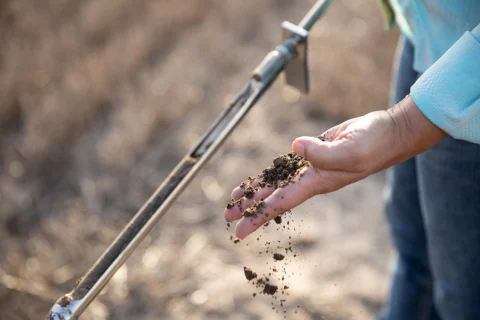
A supporting sampling lesson. Ask the receiving laboratory how it wants your soil or compost samples collected.
The sampling lesson supports the first step; it does not diagnose a phosphorus shortage or set an application rate.
Keep exploring
Sources and further reading
Have you tried this in Namibia? Share the site conditions, method and result—including what did not work—with the Living Earth community. Local observations help the next person adapt the idea.